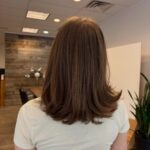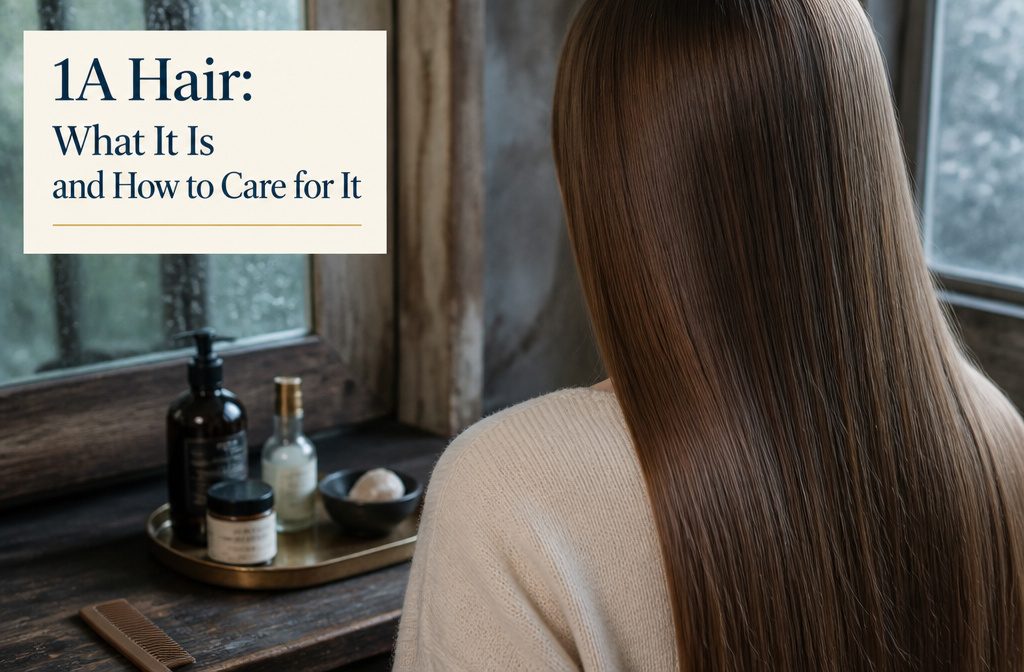
1A hair is straight hair with no bend, wave, or curl from root to tip.
The strands are fine, thin, and completely flat against the scalp, which makes them reflect light beautifully but go greasy faster than any other hair type.
Sebum slides straight down the shaft without resistance, so roots look oily within a day even when you skip heavy products.
What Type 1 Hair Means and Where 1A Fits
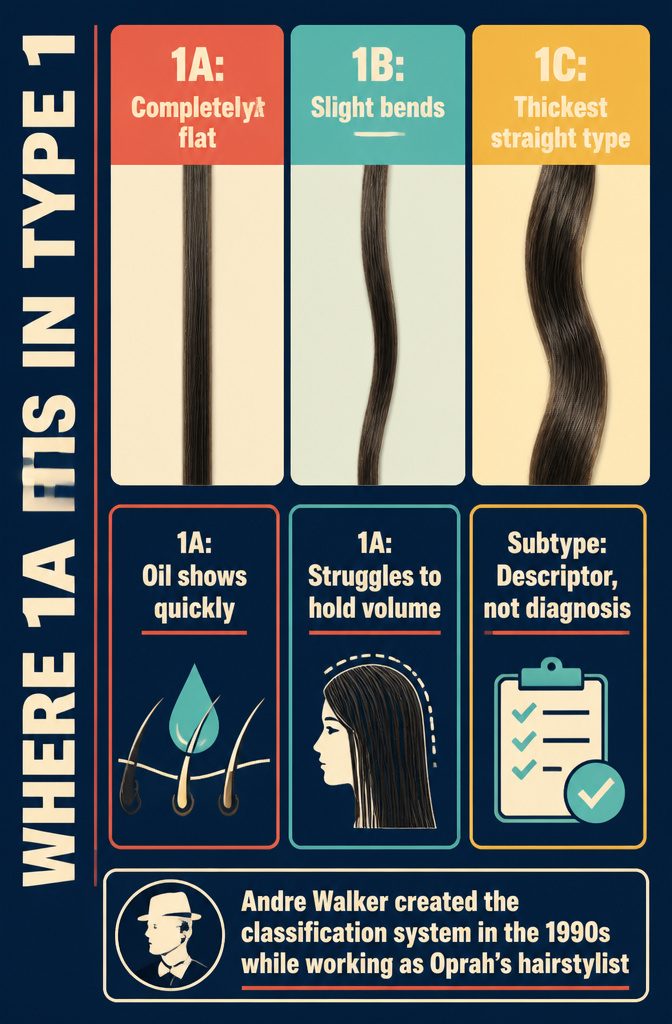
Type 1 is straight hair, broken into 1A, 1B, and 1C subtypes that progress from extremely fine and flat to thicker with more body.
Andre Walker created the classification system in the 1990s while working as Oprah’s hairstylist, and it remains the primary hair typing system in use today.
The letters mark a shift in texture: 1A lies completely flat against the scalp, shows oil quickly, and struggles to hold volume.
1B has slightly more density and body, with occasional bends that give it movement without curl. 1C is the thickest of the straight types, with enough texture and volume that frizz becomes the main concern instead of flatness.
Your head can contain more than one pattern. Density, porosity, diameter, chemical treatments, humidity, and damage all change how your hair behaves, so the subtype is a descriptor rather than a diagnosis.
Since curly hair is a dominant genetic trait, completely straight 1A hair is considerably rarer than other types.
How to Tell If You Have 1A Hair
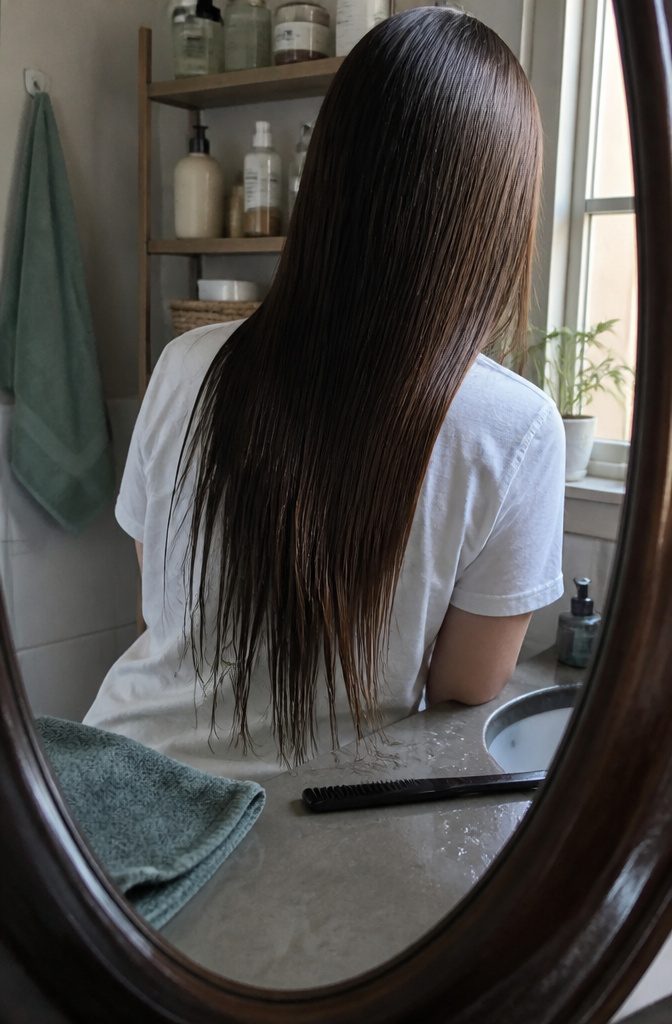
1A hair is completely straight from root to tip with no bend, wave, or curl at any point.
The strands are fine, thin, and smooth, giving them high shine but very little volume. If someone has ever called your hair thin, this subtype is probably why.
The home test is simple: let clean hair air-dry without any product or styling tools, then look at the result.
If it lies flat against your scalp with zero movement or texture, you likely have 1A. Even when wet, there is no bend anywhere along the shaft.
1A is the rarest of the straight subtypes and most common in East Asian populations. What sets it apart structurally is the cuticle count.
1A hair typically has 10 cuticle layers, and those cuticles are wider, thicker, and more tightly packed than in other types. That tight, flat arrangement is what gives the hair its reflective surface and slippery feel.
The downside to all that smoothness is that oils from the scalp travel down the shaft faster, so 1A becomes greasy quickly.
It is also easily weighed down by product and has little to no ability to hold a curl or any added texture.
1A Against 1B and 1C
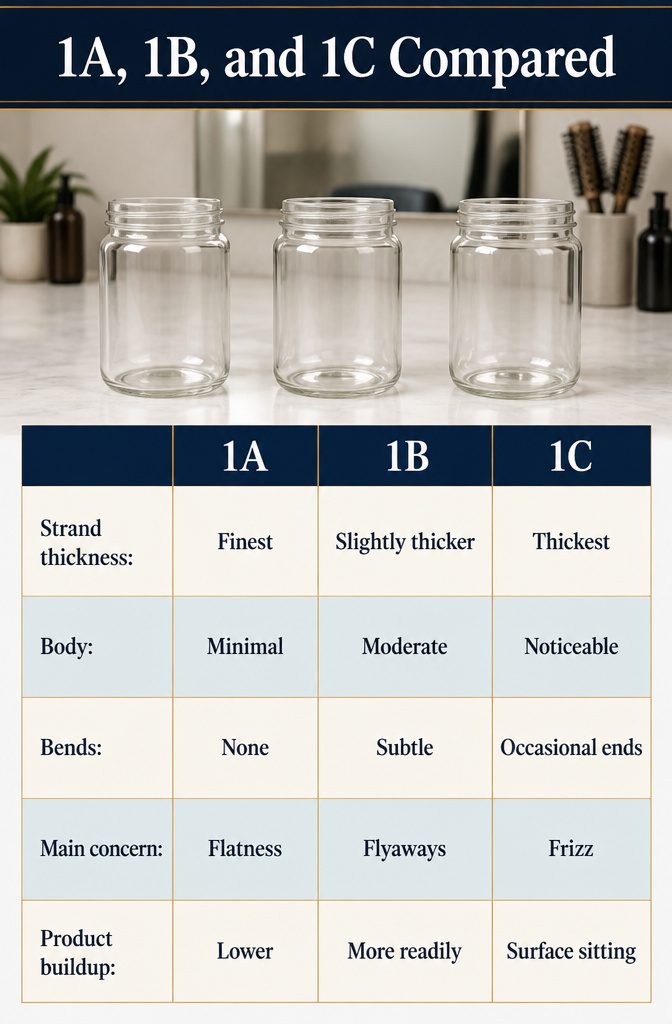
1A hair is the finest and straightest of the three, with no bends and minimal body.
The strands lie completely flat, which makes oil travel faster from root to tip and leaves the hair looking sleek but prone to going limp.
Type 1B introduces slight thickness and a subtle bend or wave when you inspect individual strands. That added body makes it easier to hold styles and gain volume, though products build up more readily and can leave the scalp greasy.
Type 1C sits at the thickest end: coarse texture, noticeable body, and occasional bends especially at the ends.
It grows outward when short, then falls forward once length adds weight. Frizz becomes the main concern with 1C, where 1A fights flatness and 1B handles flyaways and tangles.
Density, strand diameter, porosity, damage, humidity, and chemical treatments all shift how your hair behaves beyond the letter alone.
High porosity in 1A hair can make it feel dry despite the oil, while low porosity in 1C can cause products to sit on the surface.
Damage thins 1C strands and makes them act closer to 1B. Humidity adds texture to 1A that wasn’t there indoors and turns 1C frizzy if you fight the movement instead of working with it.
Washing Frequency and Product Weight
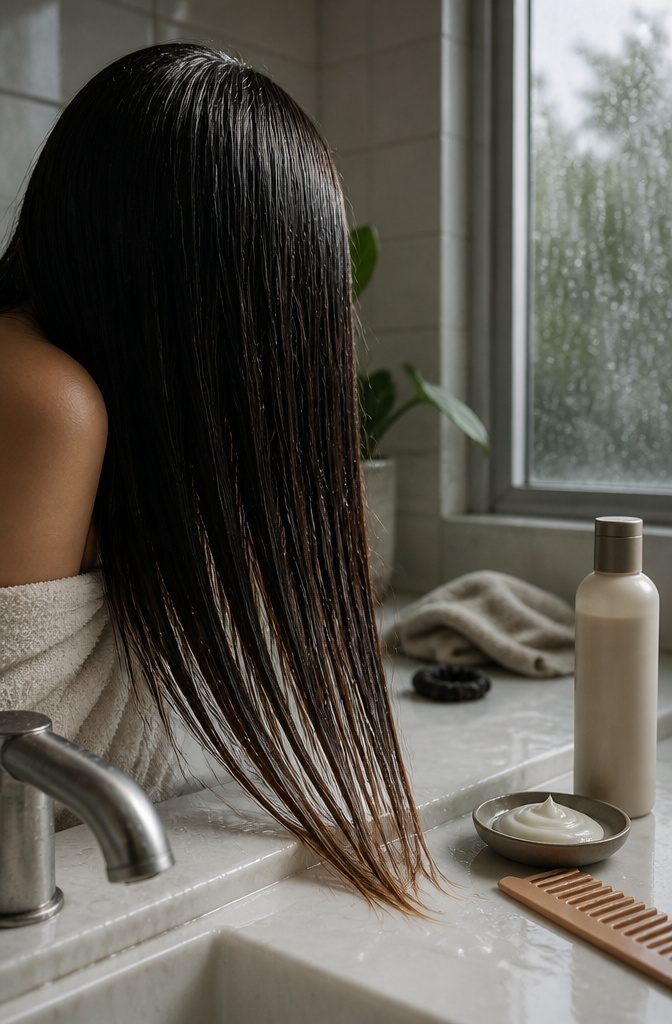
Sebum slides straight down a 1A strand without the bends that slow it on wavy or curly hair, so the roots look greasy fast even when the ends stay dry.
Wash every other day to daily if oil builds noticeably, or stretch to every two to three days if your scalp tolerates it without looking slick by afternoon.
Daily washing can push sebum production higher over time, but leaving roots oily for days weighs the hair flat and makes styling harder.
Use a gentle or volumizing shampoo that cleans without stripping.
Ouai Fine Hair Shampoo at $32 strengthens fine strands while lifting at the root. Run a clarifying formula once per month to pull out product buildup from dry shampoo, hairspray, and silicones.
Conditioner goes on mid-lengths and ends only, starting at least one inch below the scalp. Anything heavier near the roots collapses volume within an hour.
Conditioning Without Adding Weight
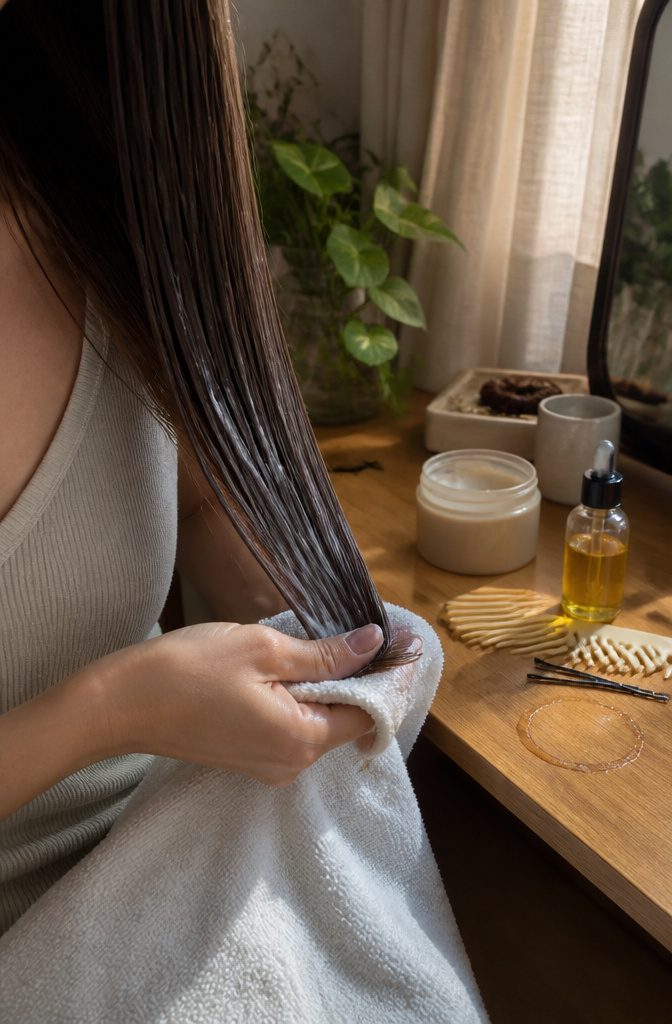
Apply conditioner starting at least an inch below the scalp, working it through mid-lengths and ends where 1A hair actually needs moisture.
The roots produce enough oil on their own. Keeping conditioner away from the scalp prevents fine strands from looking flat or greasy an hour after washing.
Hair masks once or twice a week add body and shine without the weight that daily heavy conditioning brings.
Deep-conditioning treatments make the biggest difference on dry, frizzy ends—Prismax recommends one treatment per month for 1A hair. That frequency keeps ends smooth without overdoing it.
Lightweight oils help with flyaways and tangles on 1B hair when you apply them to lengths and skip the roots entirely.
Best applied after a shower or before bed, mid-shaft down. Prose custom shampoo and conditioner start at $29.75 for 8.5 fl oz, custom hair mask from $41.65 for 8.5 fl oz, and custom hair oil from $41.65 for 1.7 fl oz.
Protecting Fine Strands From Breakage
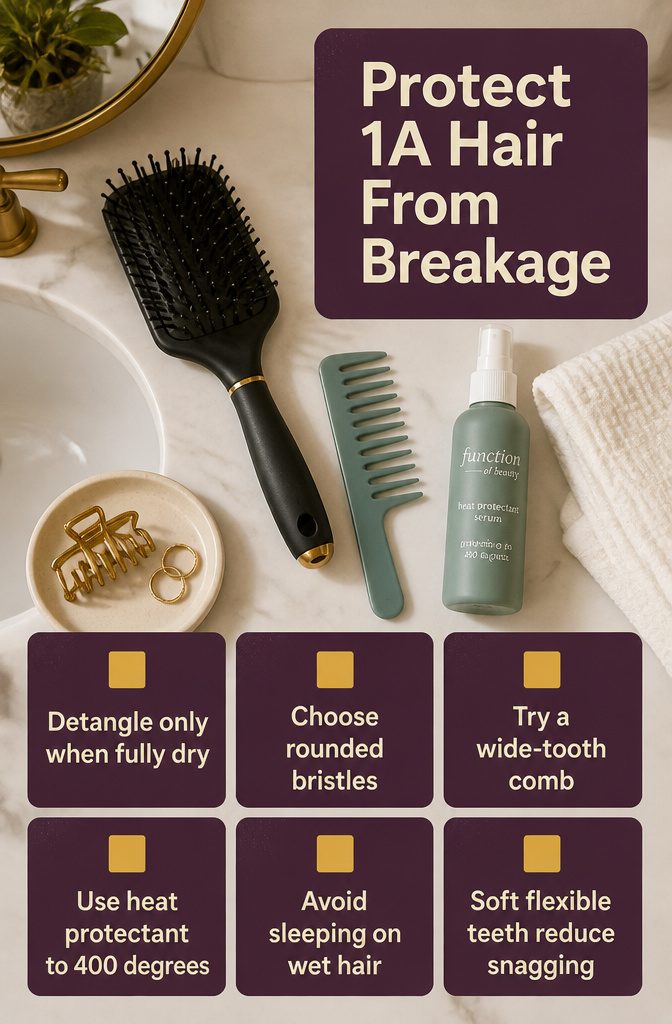
Protecting Fine Strands From Breakage
The finer texture of 1A hair makes it more fragile than thicker types, so brushing when fully dry matters more than you might expect.
Your hair is weaker and more vulnerable to breakage when wet, and pulling a brush through damp strands can tear at the cuticle. I wait until my hair is completely dry before detangling.
The brush you use makes a difference.
A paddle brush with rounded plastic bristles causes less tension while detangling, and the spaced-out prongs won’t pull. For gentler work, a wide-tooth comb or boar-bristle brush handles fine strands without snagging.
The Tangle Teezer The Ultimate Detangler runs $16–$17 and uses soft, flexible teeth. The Mason Pearson Bristle and Nylon Brush is reduced to $160 if you’re ready to invest.
If you blow-dry or heat style, use a heat protectant.
Function of Beauty’s serum protects against damage up to 400 degrees, which matters because straight hair needs extra-high temperatures to hold curls or waves. Don’t sleep on wet hair; the friction and tension overnight can snap fine strands.
Building Volume Without Weighing Down
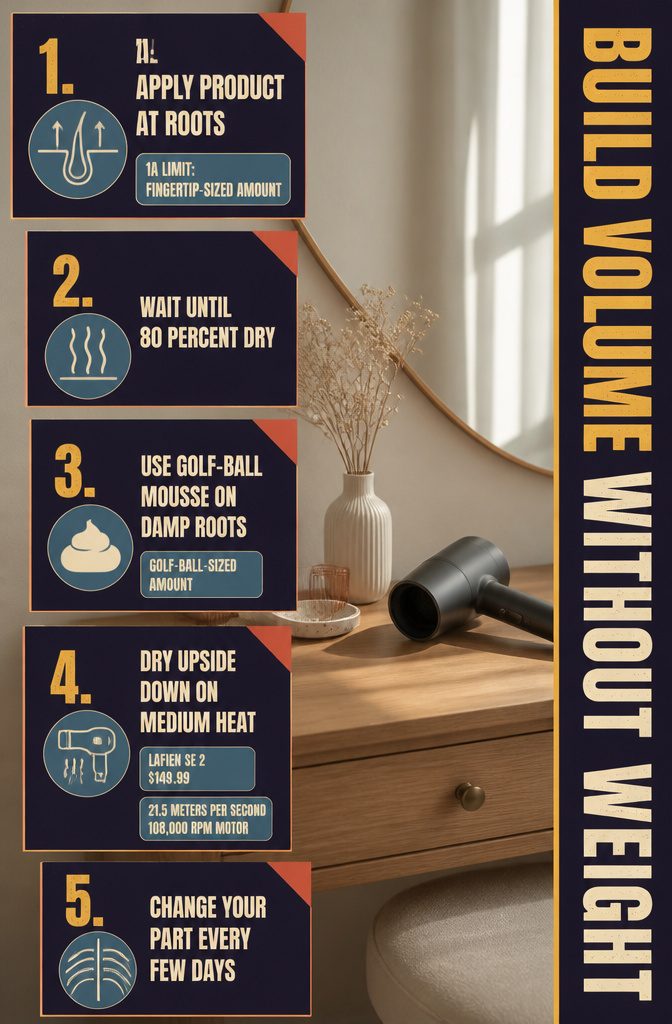
The styling product that actually builds lift goes at the roots, not the ends. For 1A, a fingertip-sized amount is the ceiling.
Anything more and the hair collapses. 1B can stretch to a dime-sized amount, 1C the same.
The safest move is applying product to hair that is already 80 percent dry. Wet hair takes too much product, and by the time it dries the weight has pulled everything flat.
Mousse is the exception. A golf-ball-sized amount worked into the roots while the hair is still damp gives structure that survives the blow-dry.
I pair it with upside-down drying to lock in volume at the scalp. The Laifen SE 2 at $149.99 moves air at 21.5 meters per second with a 108,000 RPM motor, so the process is faster than older dryers that bake fine hair.
Keep heat on medium. Type 1A burns more easily than coarser textures.
Skip anything with heavy oils, waxes, or silicone stacked high on the ingredient list. They flatten thin hair immediately.
Lightweight texturizers work better. Fekkai Full Blown Volume Dry Texturizing Spray runs $27 and adds grit without adding weight.
Changing your part every few days also lifts hair off the scalp in a way that holds longer than product alone. If you have 1C, a diffuser attachment can coax out the slight wave the subtype carries without adding frizz.
Cuts and Styles That Suit Each Subtype
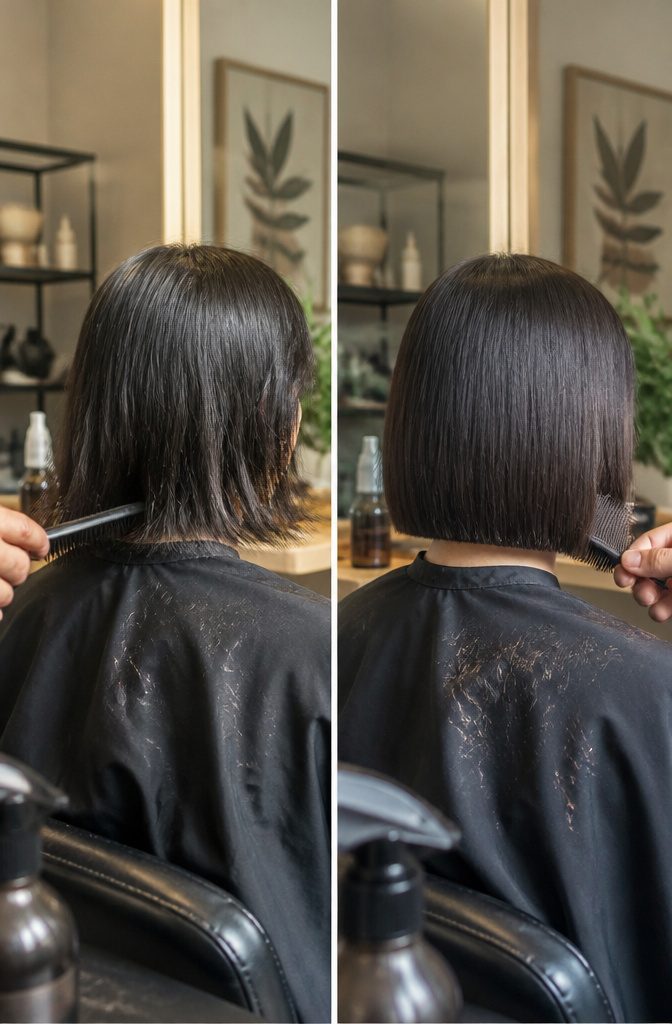
Blunt bobs dominate the 1A conversation for good reason. The solid perimeter creates the illusion of thicker hair, and the clean lines accentuate what this texture does best: lie flat and catch light.
Stylists agree that structure wins over movement when the hair is this straight and fine. Lobs work the same way, holding a strong shape without needing anything from the texture itself.
It will create an illusion of thicker hair, and it’s easy to maintain.
— Allure
That maintenance means a trip to the salon every 10 to 12 weeks to keep the perimeter crisp and split ends from traveling up the shaft.
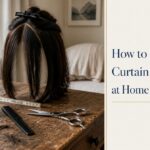
If you keep length, face-framing layers and curtain bangs add dimension without overwhelming fine strands. The bangs frame without clinging, and the layers give the eye somewhere to land.
For day-to-day styling, lean into what 1A already gives you: sleek ponytails and buns look polished with almost no effort, and side parts sit flat without product. The hair air-dries smooth, so simple straight styles take minutes.
Curls and ornate updos sit on the other end of the effort scale.
Getting 1A to hold either requires more product, more heat, and more hope than most mornings allow. Layers and textured movement get recommended more often for 1B and 1C, where the hair has enough body to carry them.
Why 1A Gets Oily So Fast
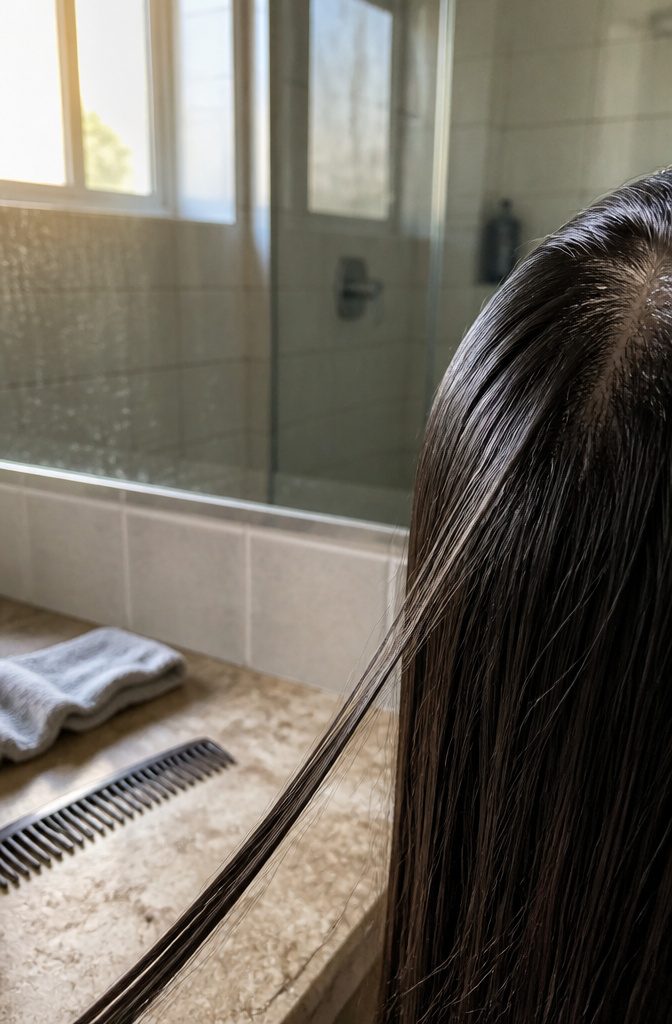
Sebum travels down a straight hair shaft without resistance. On curly hair, the coiled structure slows that journey.
On 1A, there’s no bend to get in the way, so oil makes a straight run from scalp to ends. That’s why flat, greasy roots show up faster on this hair type than on any other.
The follicle itself is part of the story. A round follicle produces a perfectly cylindrical shaft, and that smooth surface lets oil glide the full length.
It’s just biology, not a flaw. The fix sits in how often you wash and where you put conditioner, not in trying to change your hair type.
Whether 1A Can Hold a Curl
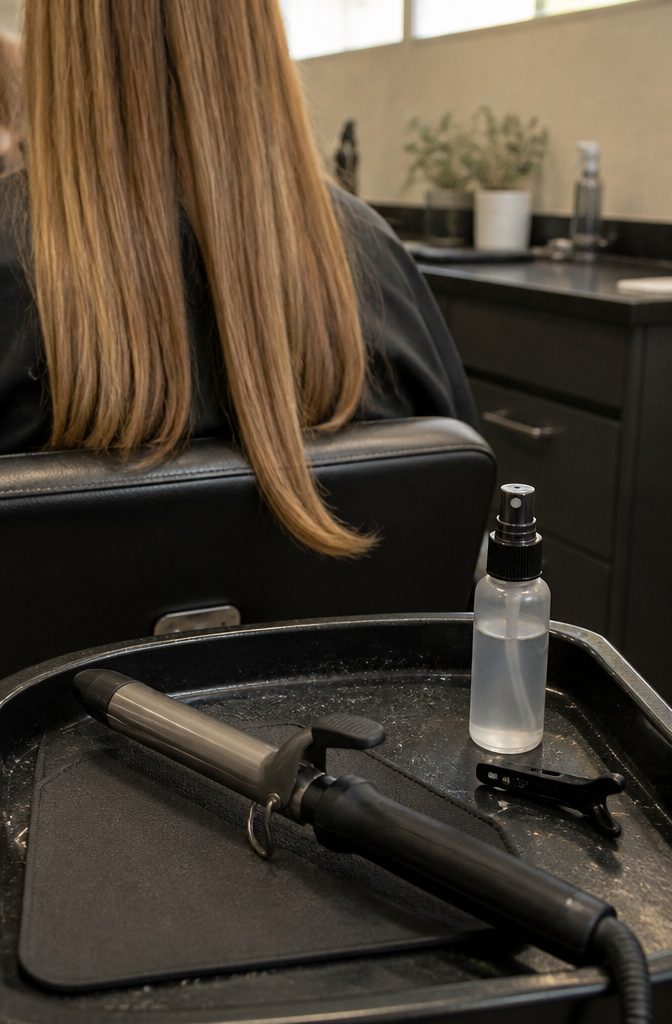
1A hair almost never holds a curl. The smooth shaft slides out of the curl pattern within an hour or two, even with hairspray or a setting product.
1B does slightly better but still needs product to give the curl any staying power. 1C, with its coarser texture and subtle natural wave, holds curls reasonably well compared to the other straight types.
If you want longer-lasting waves or volume without daily heat styling, a digital perm is worth asking your stylist about.
The chemical processing gives 1A hair semi-permanent body that air-drying alone will not provide. Fine strands break more easily than thicker hair, so any heat or chemical treatment carries extra risk.
Layering Products for Lift and Hold
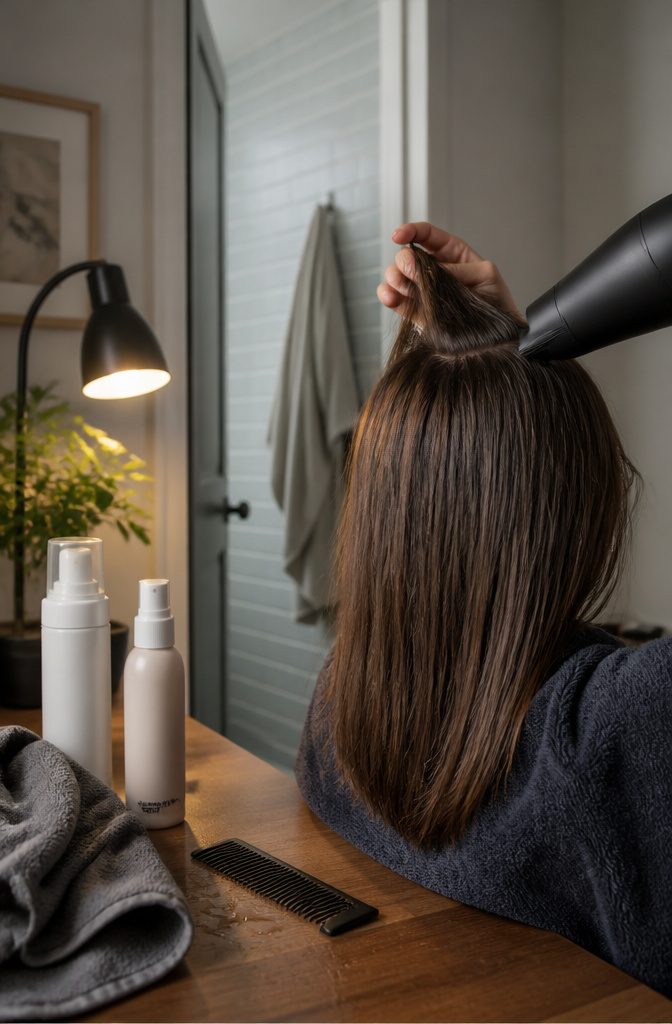
1A hair weighs down too easily to handle the kind of product layering that works for 1B and 1C.
Mousse, blow-dry spray, cream and pomade in combination can build lift, texture and hold on thicker straight hair, but fine 1A strands collapse under that much weight.
The one exception is pairing a volumizing mousse with a blow-dry spray before heat styling.
I massage a golf ball-sized amount of mousse into the roots of towel-dried hair, then spritz the blow-dry spray through the lengths. Both products should offer heat protection.
Blow dry upside down and use fingers to tousle as it dries rather than a round brush, which flattens 1A. Finish with a texturizing or sea salt spray for definition.
Pomade is better saved for 1B and 1C hair in slicked-back styles, side parts and pompadours. It holds structure without stiffness, but 1A loses volume under that kind of finish.
Frequently Asked Questions
What is type 1 hair?
Type 1 is straight hair, divided into 3 subtypes: 1A, 1B, and 1C. Each subtype marks a shift in texture, from 1A’s completely flat, fine strands to 1C’s thicker, coarser hair with more body and volume.
What is 1A type hair?
1A hair is completely straight from root to tip with no bend, wave, or curl at any point. The strands are fine, thin, and smooth, giving them high shine but very little volume, and they lie flat against the scalp.
Is 1A hair rare?
Yes, completely straight 1A hair is considerably rarer than other types. Since curly hair is a dominant genetic trait, most hair has some bend to it, making 1A the rarest of the straight subtypes.
Do I have 1A or 1B hair?
1A lies completely flat with no bend or wave and gets oily quickly, while 1B has slightly more thickness and body with a subtle bend when you inspect individual strands. 1B holds styles longer and has more volume than 1A.
What is the difference between type 1A and 1B?
1A is the finest and straightest, with no bends and minimal body, while 1B introduces slight thickness and a subtle bend or wave along the shaft. 1B is easier to style and holds volume better than 1A.
How often should you wash type 1A hair?
Wash every other day to daily if oil builds noticeably, or stretch to every 2 to 3 days if your scalp tolerates it without looking slick by afternoon.
Sebum slides straight down 1A strands without the bends that slow it on wavy or curly hair, so roots look greasy fast.
Why does my straight hair get oily so fast?
Sebum travels down a straight hair shaft without resistance. On curly hair, the coiled structure slows that journey, but on 1A there’s no bend to get in the way, so oil makes a straight run from scalp to ends.
Can straight hair hold a curl?
1A hair almost never holds a curl, with the smooth shaft sliding out of the pattern within an hour or two even with hairspray.
1B does slightly better but still needs product, while 1C holds curls reasonably well compared to the other straight types.
Is 1A hair hard to style?
It air-dries smooth and suits sleek ponytails, buns, and straight styles with almost no effort. Curls and ornate updos require more product, more heat, and more hope than most mornings allow.
Should I use hair oil for 1B hair?
A lightweight oil can help with flyaways and tangles when applied to mid-lengths and ends, not roots. Apply after a shower or before bed, mid-shaft down, to avoid weighing the hair down.
Do type 1 hair needs conditioner?
Yes, but apply conditioner starting at least an inch below the scalp, working it through mid-lengths and ends where 1A hair actually needs moisture. Anything heavier near the roots collapses volume within an hour.