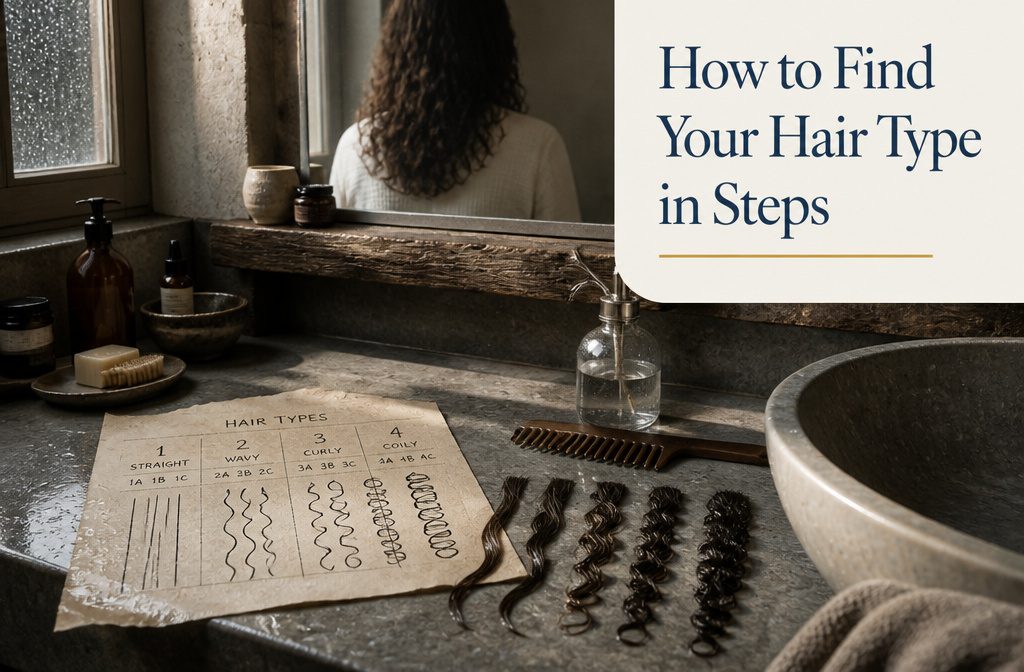
You can identify your hair type in 6 steps that take one wash cycle and about 2 hours of air-drying, though most people skip the most important part: checking multiple areas instead of picking one pattern from a single section.
Your crown, sides and underneath layers often behave differently, and forcing them all into one category means you end up with products chosen for hair you don’t actually have.
The numbered system splits patterns into 4 families and 12 subtypes, from 1A straight to 4C coily, but pattern alone doesn’t control how your hair responds to moisture or product.
1. Wash and air-dry your hair without styling products or heat
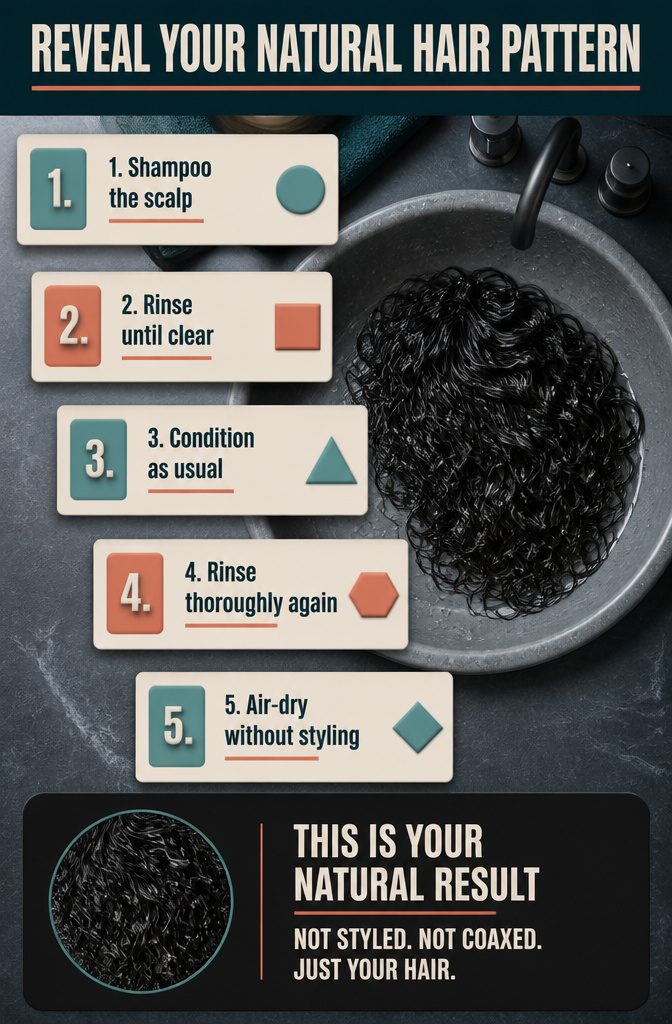
Start on freshly washed, fully rinsed hair that is then left to air-dry without any leave-in products, styling creams, oils, or hot tools.
You want to see what your hair does naturally, not what it can be coaxed into doing. Shampoo the scalp, rinse thoroughly, condition as usual, and rinse again until the water runs clear.
After that, skip the gel, mousse, curl cream, and blow-dryer. Avoid brushing or rubbing the hair hard with a towel, since both can stretch the pattern or blur what you are trying to identify.
If your hair tangles badly when left alone, you can detangle gently while it is still wet and conditioned, using fingers or a wide-tooth comb, and apply your usual leave-in if that is what makes handling comfortable.
The pattern will still show once the hair dries.
Check the shape before you reach for the flat iron or the curling wand. Look at the first result, not the finished style.
2. Compare your natural pattern with the four broad families
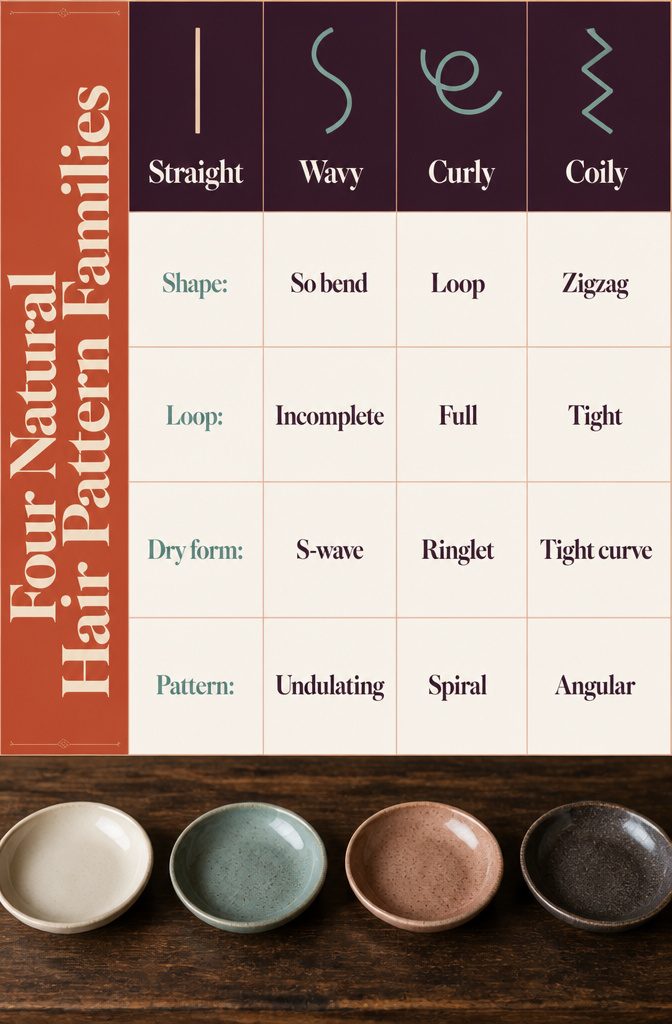
Let your hair air-dry without product, then look at the shape that forms.
Straight hair lies flat with no bend, waves create an S-shaped curve, curls turn into loops or spirals that wrap around themselves, and coils form tight curves or zigzag patterns.
Check the crown, sides, and underneath layers rather than judging from one spot.
The difference shows clearest when the hair is fully dry. Waves form that S but don’t complete a full loop.
Curls circle back on themselves in ringlets or corkscrews. Coils are tighter still, sometimes bending in a Z rather than a spiral.
If you land between two categories, ask where the pattern starts: does it form at the root or partway down the strand? Does it hold its shape dry, or does it relax out?
Some hair shows more than one pattern.
Record the two you see most often rather than forcing everything into a single type. If you prefer working from questions instead of mirror checks, NaturallyCurly offers a quiz that uses statements about appearance to narrow the result.
3. Narrow it to a numbered subtype
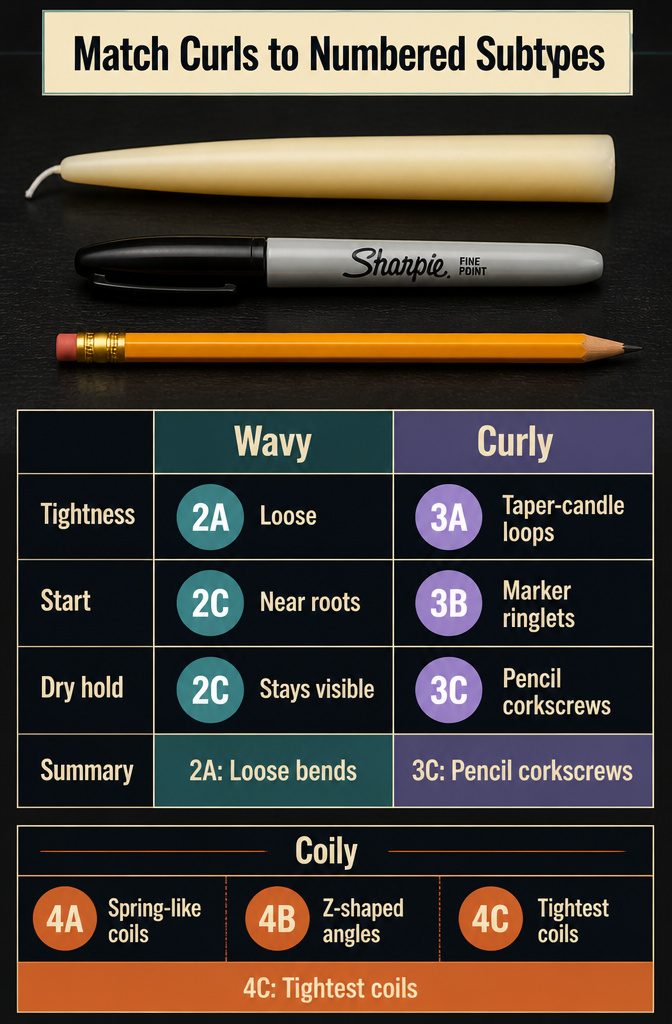
Once your pattern family is clear, the numbered subtypes break it down by how tightly the bend, wave, or coil forms.
Wavy hair moves from 2A’s loose, tousled bends that start partway down the length to 2C’s well-defined S-waves that appear closer to the root and hold more volume.
Curly patterns range from 3A loops as wide as a taper candle to 3B ringlets the diameter of a Sharpie marker, then tighten further to 3C corkscrews around pencil width.
Coily hair follows the same logic: 4A shows spring-like coils with a visible S or loop, 4B bends into sharper, Z-shaped angles, and 4C coils so tightly that individual pattern can be hard to see at a glance.
Type 3B curls have a circumference about as wide as the barrel of a Sharpie marker.
If you are deciding between borderline types, two checks settle it: does the pattern start at the root or mainly through the lengths, and does it stay visible when the hair is fully dry.
A curl that loosens to a wave once dry lands in 2C, not 3A.
4. Check multiple areas and record any mixed patterns
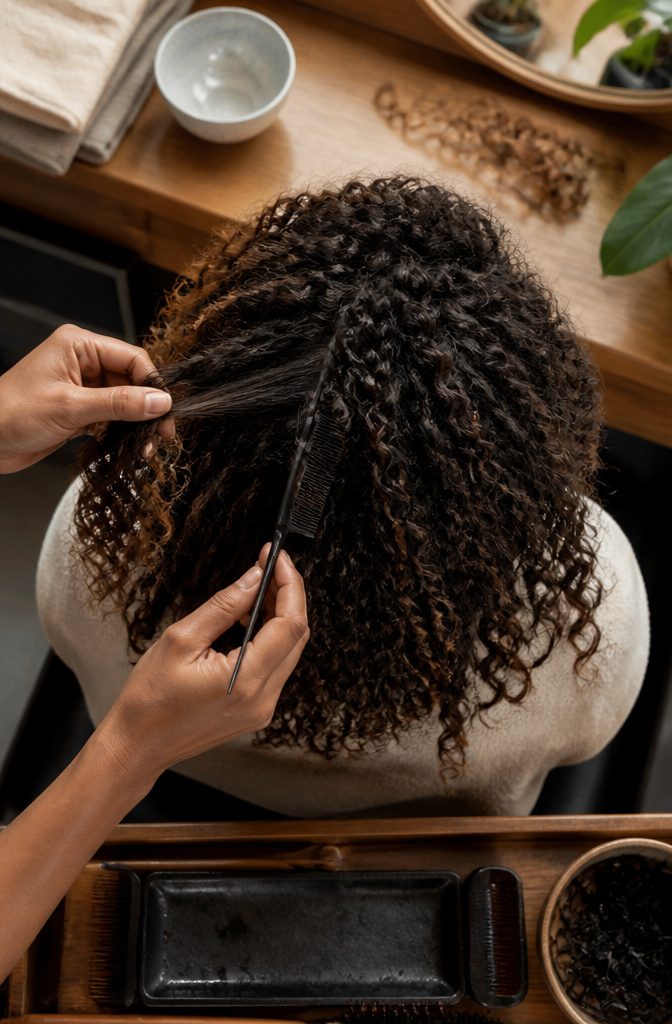
Your hair likely carries more than one curl pattern across your head, and that variation is normal.
The crown often behaves differently from the hairline, sides, or underneath layers. Rather than forcing everything into a single category, note which patterns appear and where.
You might see mostly waves with a few loose spirals underneath, or tight coils at the crown and looser curls along the sides. Keep that description instead of trying to pick just one.
If you land between categories—1C and 2A, 2C and 3A, 3C and 4A, or somewhere in the 4A/4B/4C range—compare where the pattern starts and how it forms.
Does it begin at the root or show up mainly through the lengths? Is it an S-shaped wave, a complete spiral, a corkscrew, or a tight bend?
Does it hold when the hair is fully dry? Those details clarify the boundary and give you language that works when you talk to a stylist or shop for products.
5. Test strand texture separately from pattern
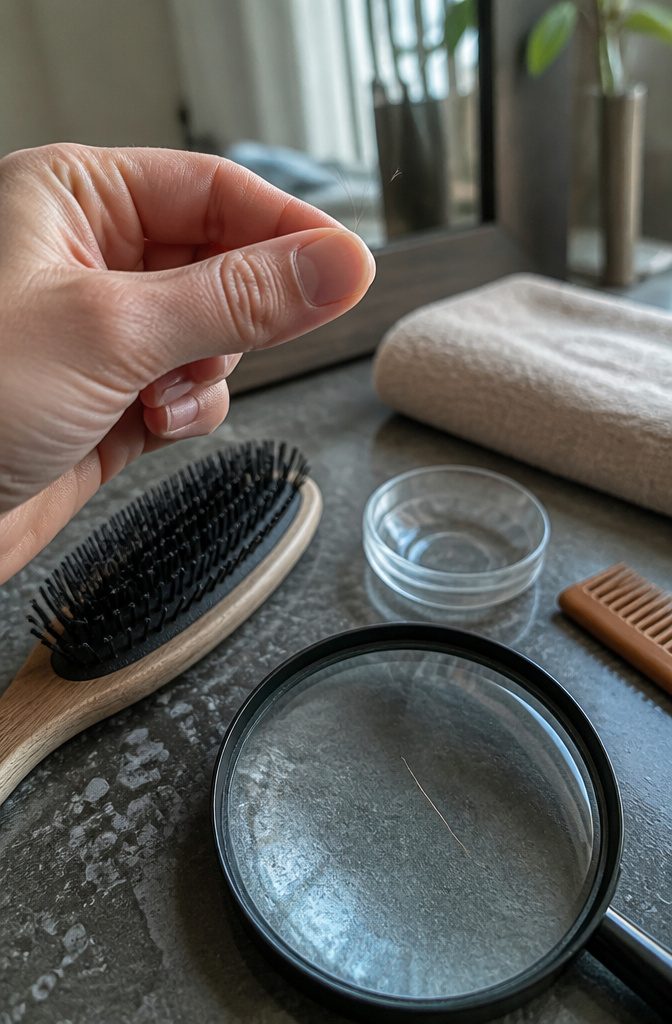
Take a clean, dry shed hair from your brush and roll it between your thumb and fingertip.
If you barely feel it, the strand is fine. If you can feel it but it doesn’t seem thick or coarse, you have medium texture.
If it feels like a distinct thread, strong and clearly thick, the strand is coarse. The difference comes down to cuticle layers: fine hair has as few as 4, coarse as many as 18.
This check measures strand diameter only.
It says nothing about your curl pattern or how much hair you have total. A person with coarse strands can still have low density, sparse coverage across the scalp.
Another with fine strands might have dense coverage that looks and feels full. The strand test isolates width, and that width decides how much product strength you need and how the hair responds to heat.
6. Measure density and check porosity
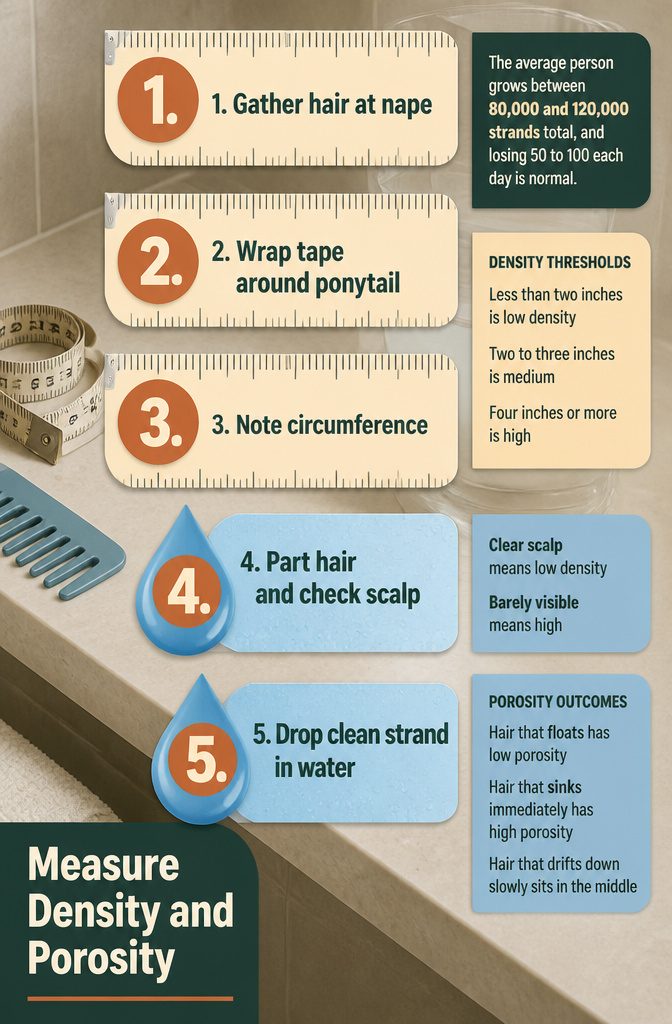
Density tells you how many strands fill each square inch of scalp.
The average person grows between 80,000 and 120,000 strands total, and losing 50 to 100 each day is normal. I measure mine using the ponytail method: gather your hair at the nape, wrap a tape measure around the ponytail, and note the circumference.
Less than two inches is low density, two to three inches is medium, and four inches or more is high.
For short hair or bangs, part a section with a comb and check how much scalp shows through. Clear scalp means low density, barely visible means high.
Porosity is different. It measures how easily your hair absorbs and holds moisture.
The cuticle sits tightly closed on low-porosity hair, making water and product bead on the surface. High-porosity hair has gaps in the cuticle, so moisture rushes in but escapes just as fast.
Drop a clean strand in room-temperature water. Hair that floats has low porosity, hair that sinks immediately has high porosity, and hair that drifts down slowly sits in the middle.
What the numbered hair-type system means
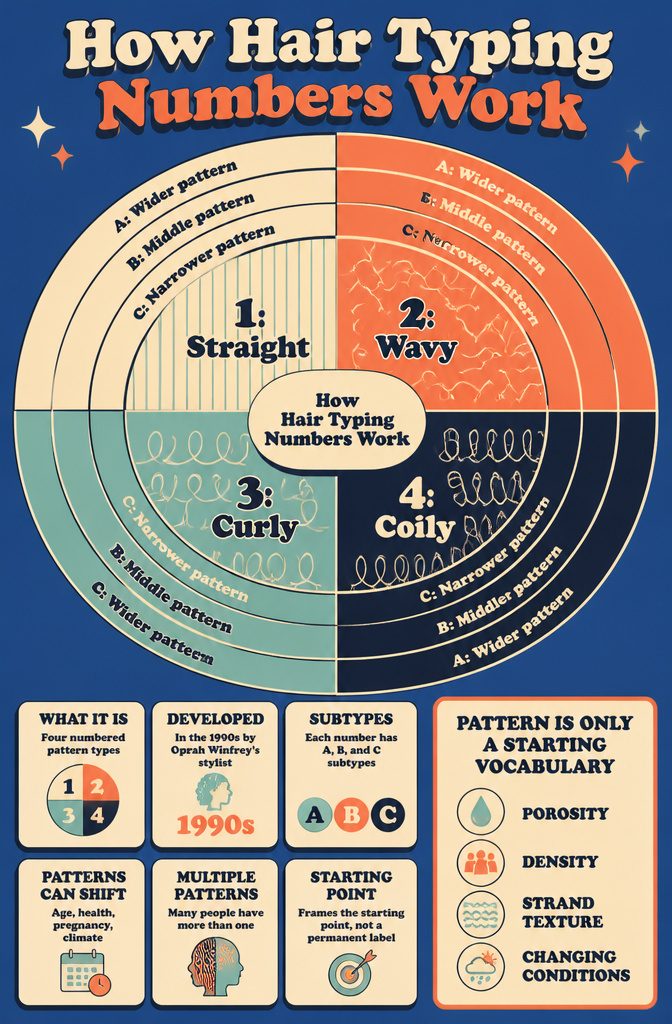
The Andre Walker Hair Typing System groups hair into four numbered pattern types based on shape: 1 for straight, 2 for wavy, 3 for curly, and 4 for coily.
Developed in the 1990s by Oprah Winfrey’s stylist, the chart has evolved among stylists to cover the full range from very straight to tightly coiled patterns.
Each number is divided into A, B, and C subtypes that describe how tight or loose the pattern runs within that family. A generally marks a wider, looser pattern, C a narrower, tighter one.
The system gives you a vocabulary to describe what you see, but experts point out that pattern alone is not your full hair type.
Porosity, density, and strand texture all shape how your hair behaves, and many people carry more than one curl pattern across different parts of the head.
Pattern can shift over time with age, health, pregnancy, and climate, so the number you land on today frames the starting point rather than locking you into a permanent category.
Hair pattern versus strand texture versus density
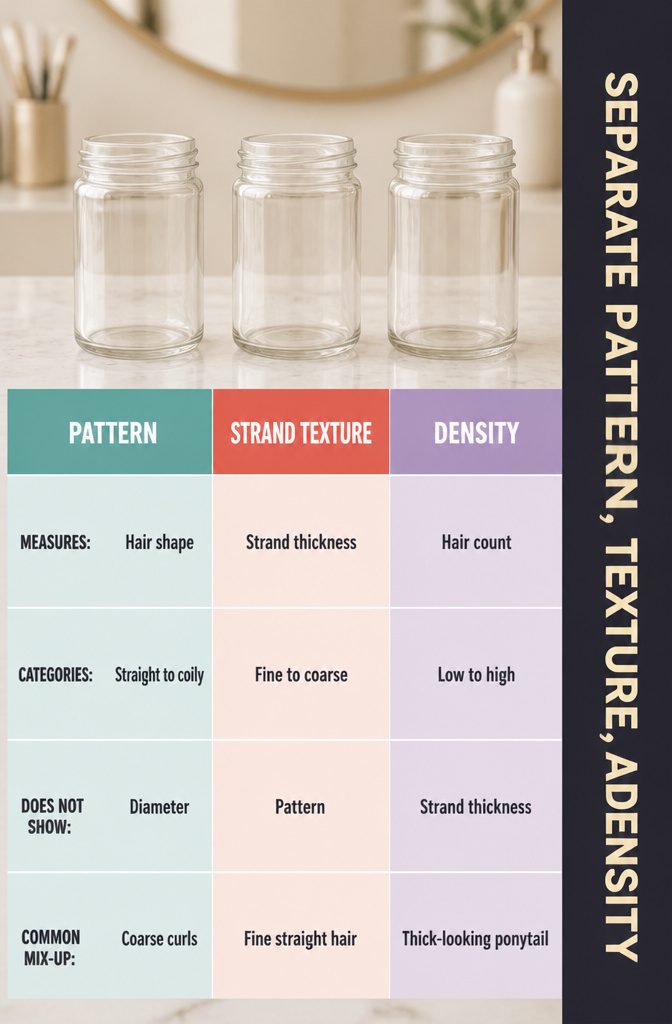
The three things most people jumble are pattern, strand texture, and density—and they measure completely different features. Pattern is the shape: straight, wavy, curly, or coily.
Strand texture is the thickness of a single hair, labeled fine, medium, or coarse. Density is how many hairs grow per square inch of your scalp.
Curly hair is not automatically coarse, and straight hair is not automatically fine. A wide spiral can be made of fine strands.
A strand that lies straight can still be relatively thick. The pattern says nothing about the diameter of the individual hair.
Coarse does not mean rough or damaged, either.
It describes a larger strand diameter, full stop. And a thick-looking ponytail is not the same thing as a thick individual strand.
You may have many fine hairs or fewer coarse ones. That difference is density, which is separate again.
Porosity and what it does to moisture and product response

Porosity sits apart from pattern and texture.
It measures how easily your hair absorbs moisture and how well it holds on to it. A strand with tightly packed cuticle layers resists water and product, meaning both tend to sit on the surface rather than soak in.
That gives you low porosity. Cuticles spaced farther apart let moisture move in quickly, but they also let it escape just as fast.
That is high porosity, which shows up naturally in some people and develops in others after chemical processing, heat damage, or bleach. Medium porosity keeps the best balance and usually behaves the most predictably.
The difference shows in how hair responds to humid weather.
High-porosity hair pulls moisture from the air and frizzes. Low-porosity hair resists environmental moisture and also resists the conditioner you apply, which leads to buildup if you use creams and butters without clarifying regularly.
Highly porous hair dries out fast because the cuticle does not trap what it takes in, so it often needs leave-in treatments, masks, or protein products to smooth the raised layers and seal them down.
One straightforward check involves a glass of room-temperature water and a few strands plucked from different parts of your head after washing. Hair that floats signals low porosity.
Hair that sinks slowly sits in the medium range. Hair that drops straight to the bottom indicates high porosity.
Another option is to spray a section with water and watch how long absorption takes. Quick absorption points to high porosity; water that beads up and rolls off suggests low.
When patterns vary across your head or appear to change
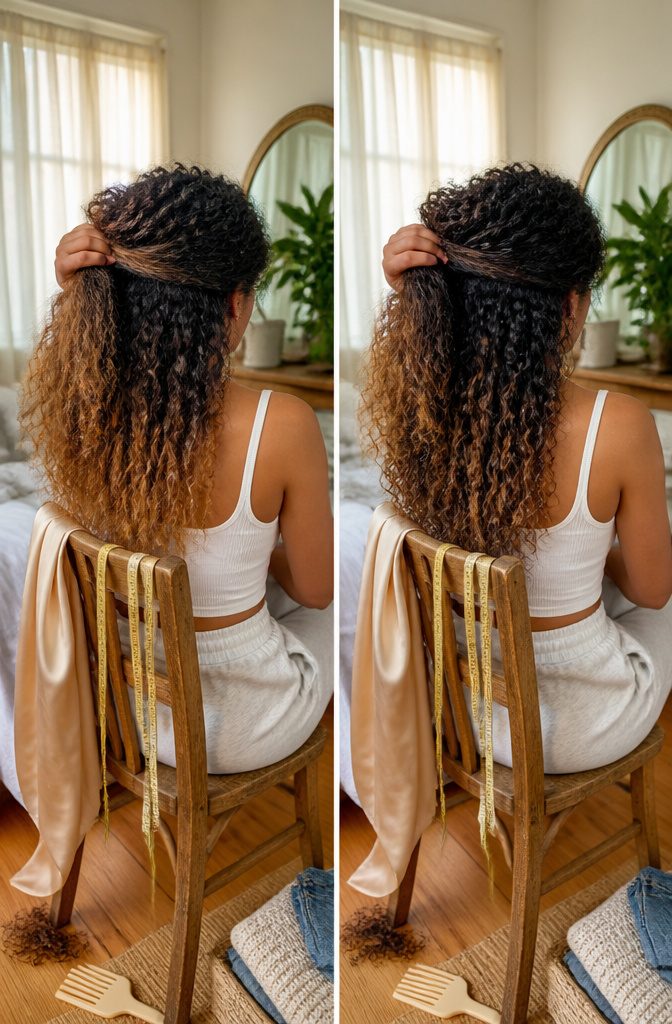
Patterns can differ from one part of your head to another. A wave near your face and a loose spiral underneath both count as real, and neither one means you misread the chart.
Instead of forcing yourself to pick a single label, write down what you actually see: mostly waves, with a few tighter spirals at the crown.
That plain description is more useful than trying to flatten the variation into one number and letter.
Those patterns can also shift over time. Age, hormones, heat styling, chemical treatments, and even weather can change how your hair behaves.
If the change feels sustained rather than temporary, reassess by looking at clean, air-dried new growth. After chemical straightening, assess the untreated roots separately so you know what is growing in versus what the treatment left behind.
Type 4c hair can shrink up to seventy percent when dry, which sometimes reads as a pattern change when it is really just how that texture behaves without tension.
Frequently Asked Questions
What’s the difference between hair type and texture?
Hair type is the natural curl pattern your hair forms—straight, wavy, curly, or coily.
Texture is the thickness of a single strand, described as fine, medium, or coarse. Curly hair can be made of fine strands, and straight hair can have coarse ones; the two measurements describe separate features.
Can you have more than one hair type?
Yes, different areas of your head often show different patterns, and that variation is normal.
The crown may behave differently from the sides or underneath layers. Rather than forcing everything into a single category, note which patterns appear and where.
How do I determine my hair type?
Wash your hair, rinse thoroughly, and let it air-dry without products or heat tools.
Once fully dry, compare the pattern that forms with the four families: straight hair lies flat with no bend, waves create an S-shaped curve, curls turn into loops or spirals, and coils form tight curves or zigzag patterns.
What is the hair typing system?
The Andre Walker Hair Typing System groups hair into 4 numbered pattern types based on shape: 1 for straight, 2 for wavy, 3 for curly, and 4 for coily.
Each number is divided into A, B, and C subtypes that describe how tight or loose the pattern runs within that family.
How do you determine your hair texture?
Take a clean, dry shed hair from your brush and roll it between your thumb and fingertip.
If you barely feel it, the strand is fine; if you can feel it but it doesn’t seem thick, you have medium texture; if it feels like a distinct thread, the strand is coarse.
Does your hair type determine what products you should use?
Not by itself.
Pattern is only one piece; strand diameter, density, porosity, scalp condition, treatment history, and your desired result all shape how your hair responds to products. You need to consider all of those factors when choosing what to apply.
Does your hair type change over time?
Visible patterns can shift temporarily or longer-term with age, hormones, heat styling, chemical treatments, and climate.
If the change feels sustained rather than temporary, reassess by looking at clean, air-dried new growth to see what is growing in versus what past treatments left behind.
What is the difference between 4B and 4C hair?
4B hair bends into sharper, Z-shaped angles, while 4C coils so tightly that individual pattern can be hard to see at a glance.
Both are tight coil patterns; the difference is how the coil forms and how visible that formation is when dry.