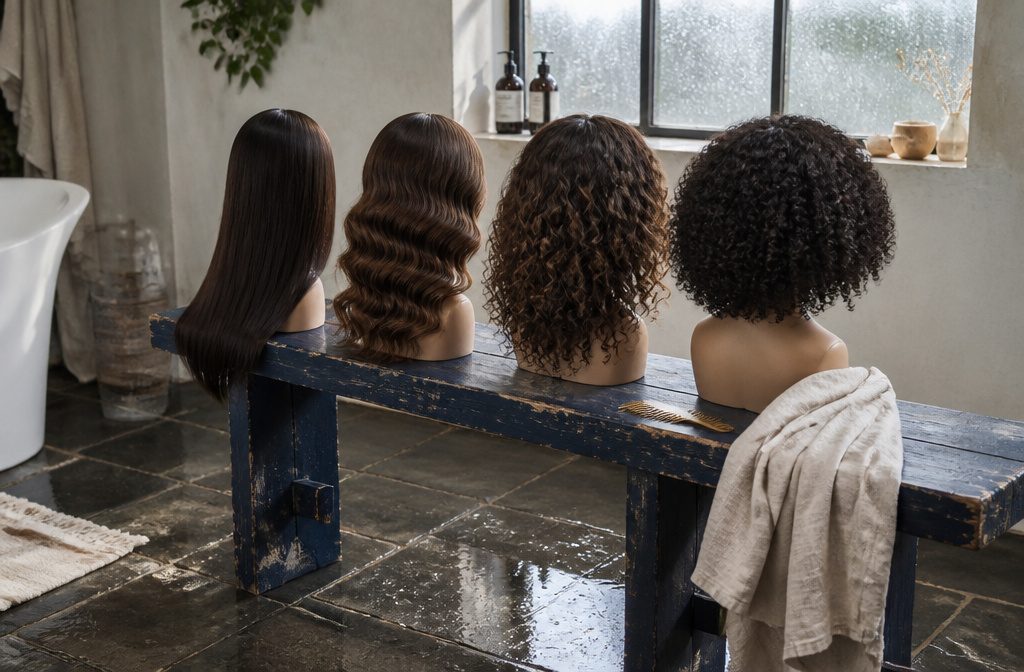
A different hair types chart sorts hair from straight to coily using a numbered scale, then splits each number by letter to mark how loose or tight the pattern runs.
The system leaves out porosity, density and strand thickness, all of which change how hair actually behaves when you style it.
Type 3A curls might be one inch wide, but two people with that pattern can need opposite products if one has fine strands and the other coarse.
How the 1A–4C Hair Type Chart Works
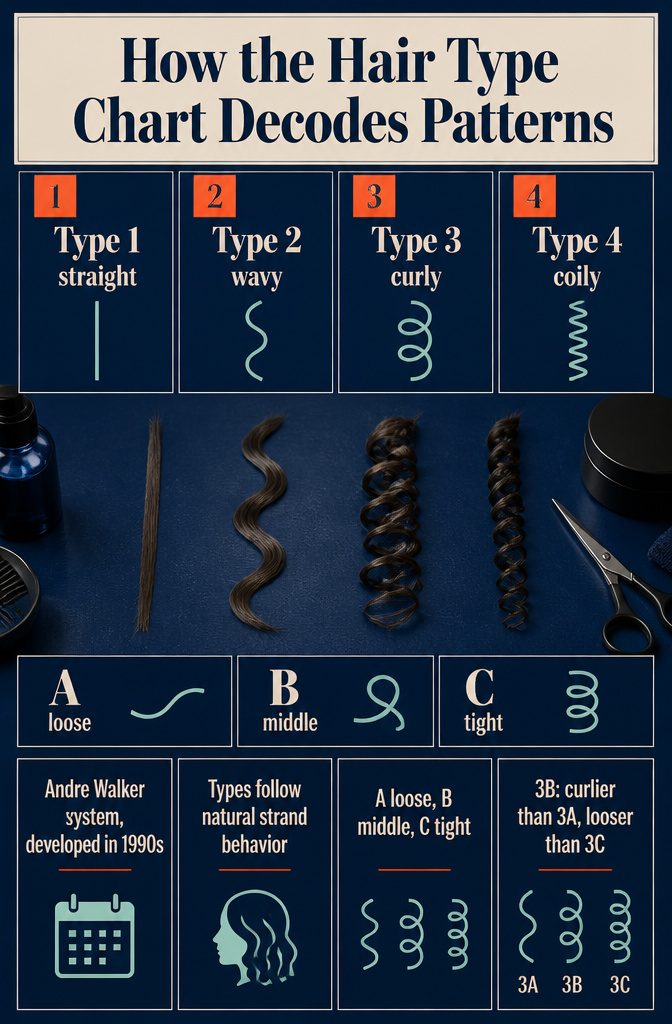
The system most people use was developed by Andre Walker in the 1990s.
It sorts hair into four numbered types based on how the strand behaves when it grows naturally. Type 1 is straight, Type 2 wavy, Type 3 curly, and Type 4 coily.
Within each type, letters A through C describe how wide or tight the pattern runs. A generally means a looser, wider pattern.
B sits in the middle. C marks the tightest curl or coil in that family.
The chart gives you a shorthand.
If someone mentions 3B hair, you know it falls in the curly range with a tighter spiral than 3A but not as tight as 3C. The same logic applies across all four types.
Straight hair stays at Type 1 with no letter subdivisions in some versions, though others split it by texture. Wavy, curly, and coily hair all get the A-B-C breakdown, and the tighter the letter, the more defined the bend.
Type 1: Straight Hair
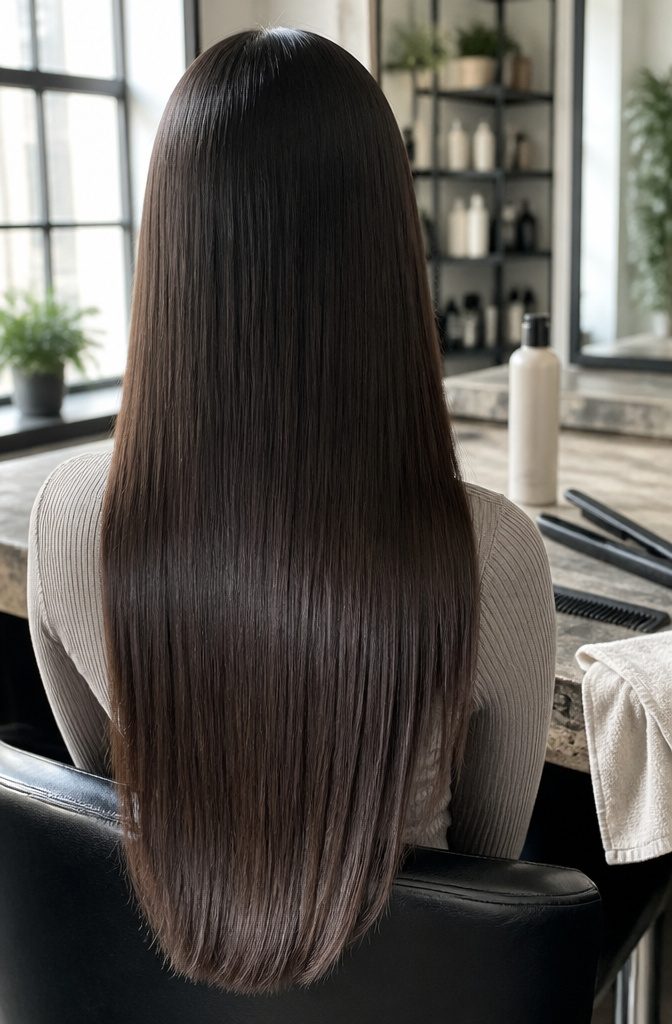
Type 1 hair has little to no natural bend, running flat from root to tip. The shaft lies straight, so light bounces off evenly and the result reads glossy without product.
That same straightness lets sebum slide down the strand faster than it can on wavy or coiled patterns, which means roots can look oily within a day or two of washing.
The category splits into three subtypes.
1A is the finest and straightest: stick-straight strands that refuse to hold a curl and often lack volume at the crown. 1B carries slightly more body, with medium-weight strands and a bit more natural lift.
1C is thicker, with a subtle bend near the ends that gives it more texture than the finer subtypes but still reads unmistakably straight when it air-dries.
Styling this type means working around low volume and fast oil migration. Lightweight shampoos and conditioners keep roots from looking heavy by midday, and heat tools grip better than they do on textured patterns.
Curls and waves tend to drop within hours unless you use a strong hold product, and even then the odds are not great.
Type 2: Wavy Hair

Type 2 hair forms an S-shaped wave pattern that sits between straight and curly.
The category breaks into three levels. 2A shows loose bends that often start below the roots, 2B has more defined elongated waves, and 2C forms thicker waves closer to the crown that can border on curls.
Frizz and products that weigh waves down are the two recurring problems. Creams and gels often flatten the pattern instead of defining it, so mousse or a lightweight leave-in serum tends to work better.
Natural oils like coconut or Jamaican black castor oil can make hair look greasy if left in, but they work well as a pre-shampoo treatment rinsed out before styling.
Shampoo every 2–3 days for 2A and 2B, or every 3–5 days for 2C. The coarser the wave, the less often it needs washing.
Type 3: Curly Hair
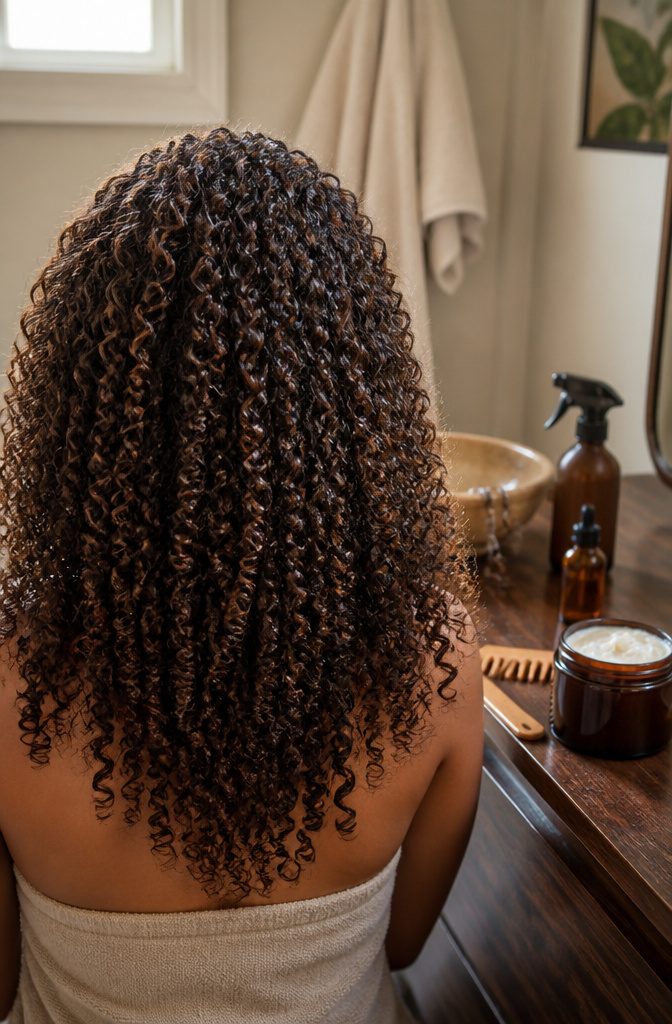
Type 3 hair forms defined spirals, loops, or corkscrews that spring from the root and hold their shape without heat.
The curl diameter separates the three subtypes. Type 3A curls are about one to one and a half inches wide, loose enough to fit around a piece of sidewalk chalk.
3B tightens to roughly half an inch, the width of a marker, and shrinks one to two inches when it dries.
3C curls are a quarter inch or smaller, as narrow as a drinking straw, and coil tightly from root to end.
Hardges warns that shampooing too frequently is not good for your hair (since it can dry your curls out), and that you should aim to shampoo every five to seven days for healthier-looking curls.
— Glamour
That washing schedule matters because the spiral shape makes it harder for natural oils to travel down the strand.
Dryness and frizz are common, so hydration becomes the main work. Deep conditioning every one to two weeks keeps Type 3 and Type 4 hair from drying out, according to NaturAll.
Between washes, a daily moisturizer on the ends and a lightweight oil while hair is still wet help seal in moisture without weighing the curl down.
Type 4: Coily or Kinky Hair
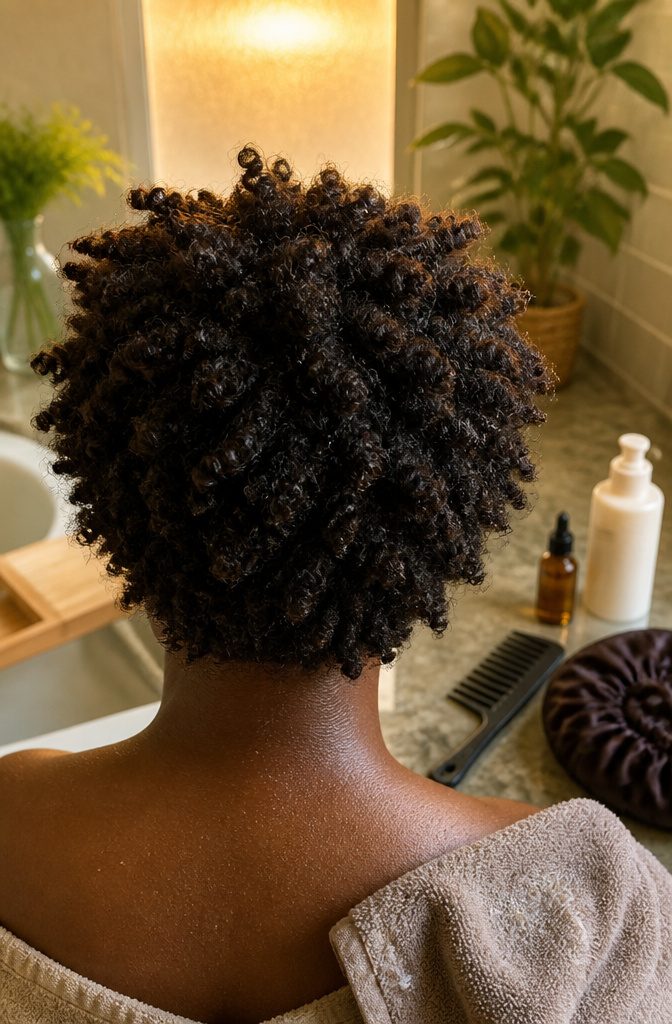
Type 4 hair has tight coils, bends, or zigzag patterns that start right at the root.
4A forms small, defined S-shaped coils about the width of a crochet needle, 4B commonly forms a Z-shaped pattern, and 4C is the tightest with coils that may be harder to distinguish without styling.
All three show noticeable shrinkage when dry.
The strands themselves can be fine and fragile despite looking dense and full.
Moisture loss and breakage are the two biggest risks, so you want to retain hydration and limit manipulation. NaturAll recommends shampooing no more than once a week, and as little as once every two to three weeks.
Between washes, you can use conditioner alone if your hair feels dirty. Daily moisturizing with a leave-in or lightweight product keeps the strands from drying out, and sealing with oil at the roots and ends locks that moisture in.
How to Identify Your Natural Pattern
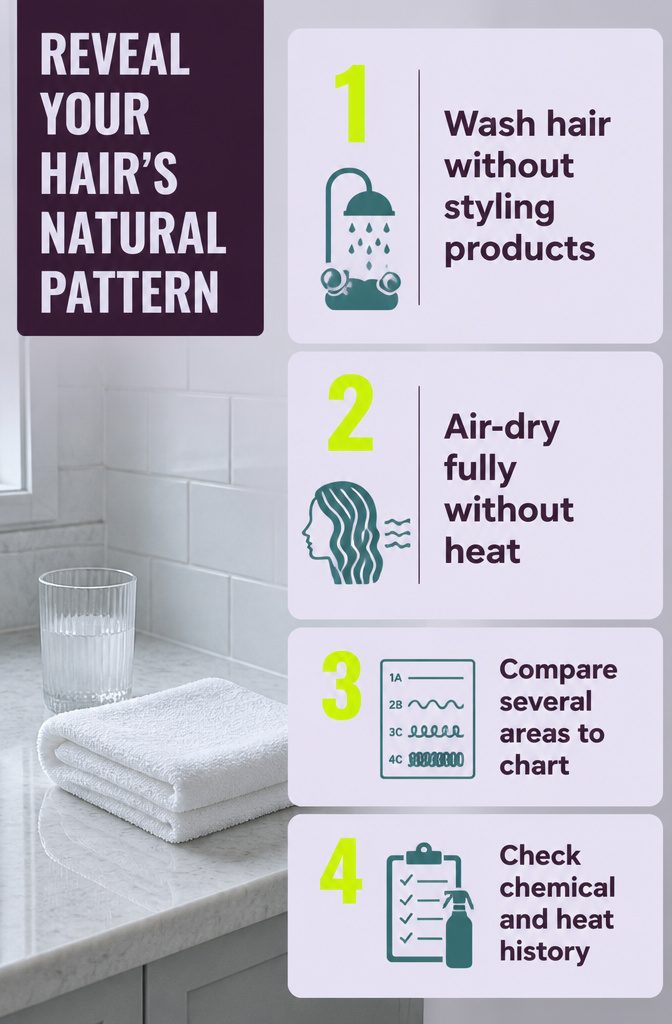
- Wash your hair and let it air-dry completely without any leave-in products, styling creams, or heat. You want to see what the hair does on its own, so skip the diffuser, the flat iron, and anything you would normally apply after the shower.
- Once dry, compare the pattern you see to a 1A–4C chart. Look at several areas of your head rather than just one section, because more than one hair type can be present on the same scalp.
- Keep in mind that chemical treatments and repeated heat styling can obscure the natural pattern. If your hair has been relaxed, permed, or straightened regularly, what you see may not reflect what it would do untreated.
Add Strand Texture: Fine, Medium, and Coarse
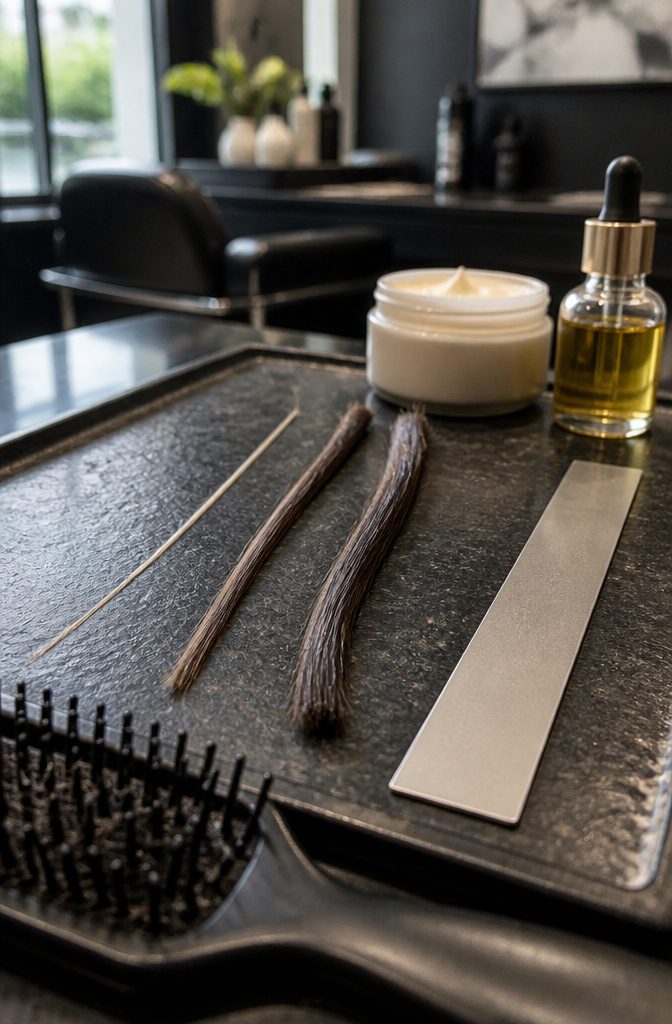
Strand texture describes the diameter of each individual hair, not how much curl it has.
This is separate from the 1–4 typing system. A strand can be straight and coarse, or coily and fine.
There are three textures. Fine strands are thin and delicate, hard to feel between your fingers when you rub one.
Medium strands feel present but not thick. Coarse strands feel like a piece of thread, easy to detect by touch alone.
Texture affects how hair responds to products and styling. Fine hair tangles easily, gets weighed down by heavy conditioners, and often will not hold a style.
Coarse hair tends toward dryness and benefits from rich conditioners or oils. Medium hair sits in between and handles a wider range of products without looking flat or feeling stripped.
Texture is not the same as density. You can have fine strands but a lot of them, which reads as thick hair overall, or coarse strands with low density that looks sparse.
Density measures how many hairs grow per square inch of scalp. Texture measures one strand at a time.
Add Density: How Much Hair You Have
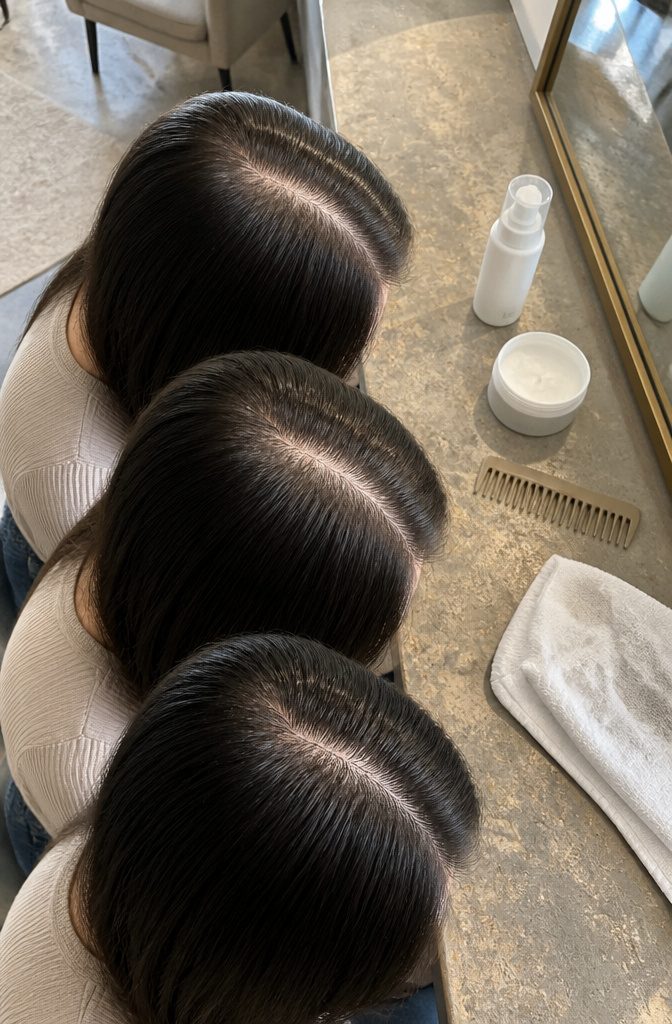
Density describes how many hairs grow per square inch of your scalp, which is separate from how thick each individual strand is.
You can have fine hair that is dense, or coarse hair that is sparse. Texture is about the strand itself; density is about how much of it you have.
The three categories are thin, normal, and thick. Thin density means fewer strands packed onto the scalp, so hair can look flatter or more see-through at the roots, and ponytails feel smaller.
Thick density is the opposite: more hair per square inch, which gives fuller coverage and can handle heavier products without going limp. Normal sits in the middle.
I find density matters more for product choice than most people expect. High-density hair can take richer creams and oils without looking weighed down, while low-density hair needs lighter formulas and volumizing techniques to avoid going flat.
Add Porosity and Moisture Behavior
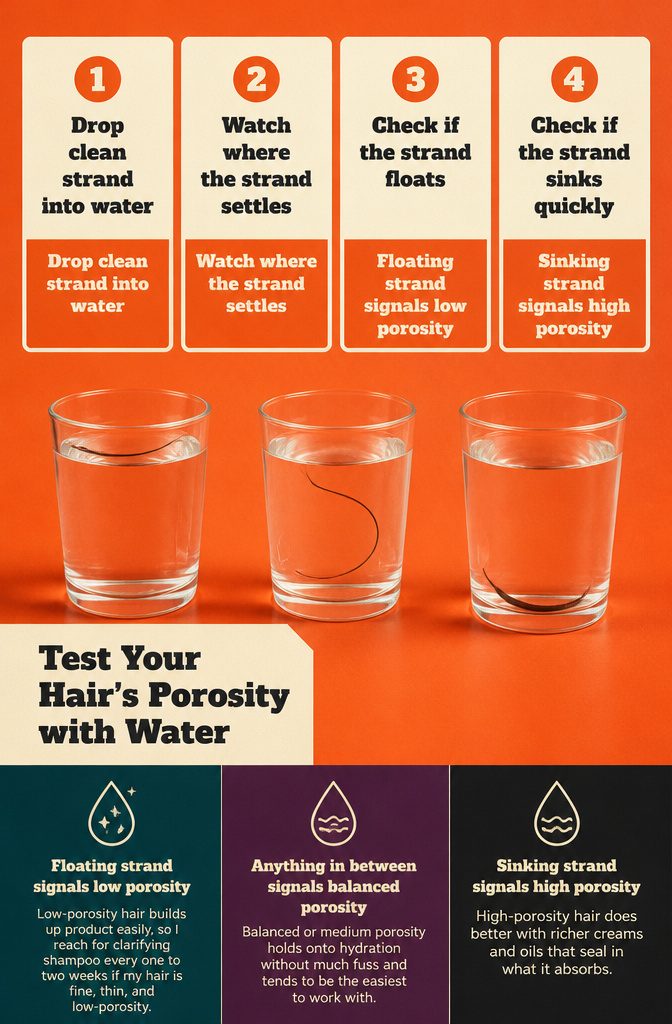
Porosity describes how easily your hair absorbs and retains moisture, and it matters when you pick products. Low-porosity hair has a tightly packed cuticle, so water and conditioner tend to sit on the surface instead of soaking in.
High-porosity hair drinks up moisture fast but loses it just as quickly, which often leads to dryness and frizz. Balanced or medium porosity holds onto hydration without much fuss and tends to be the easiest to work with.
The simplest way to figure out where you land is the water test.
Drop a clean strand or a few ends into a glass of water and watch what happens. If it floats, porosity is low.
If it sinks quickly, porosity is high. Anything in between signals balanced porosity.
Low-porosity hair builds up product easily, so I reach for clarifying shampoo every one to two weeks if my hair is fine, thin, and low-porosity. High-porosity hair does better with richer creams and oils that seal in what it absorbs.
When You Have More Than One Pattern
Several sources confirm that having more than one curl pattern on your head is completely normal.
The hair at your crown might read as 4C while the front comes in 4B, or your hairline waves differently than the bulk at the back.
When that happens, compare a few different sections and identify the pattern that covers the largest area.
If your hair is mostly 4C with a 4B section up front, you can think of yourself as 4C/4B and lean toward products and methods that suit the dominant pattern.
Curl typing gives you a starting point, not a prescription.
Porosity decides how moisture moves in and out of the strand, density tells you how much hair you’re working with, and strand thickness affects how products sit and how much weight your hair can carry.
Damage shifts behavior too. A curl pattern helps you narrow the field, but the other factors decide what actually works day to day.
Why Pattern Alone Does Not Predict How Hair Behaves
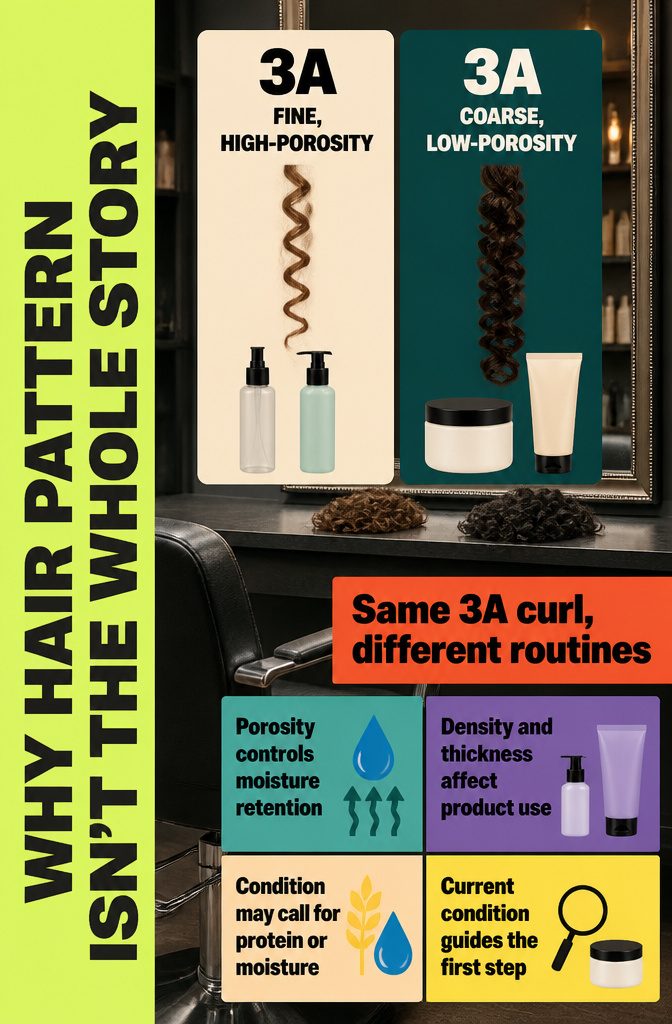
The curl pattern chart gives you a starting point for choosing products and methods, but porosity, density, and strand thickness shape how hair actually behaves.
Two people with the same 3A curl may need completely different routines if one has fine, high-porosity hair and the other has coarse, low-porosity strands.
The fine version drinks up lightweight leave-ins and dries fast. The coarse version needs heavier cream and takes longer to saturate.
Damage changes the picture further.
Heat-treated ends on naturally curly hair may look straight or lose definition, while the new growth still coils. I have seen wavy hair weighed down by buildup read as straight until clarified, then spring back.
The chart tells you what pattern you are working with. Porosity tells you how much moisture gets in and stays.
Density and strand thickness tell you how much product to use and how long styling takes. Current condition tells you whether your hair needs protein, moisture, or a reset before any method works the way it should.
Hair Type Is Not Determined by Race or Ethnicity
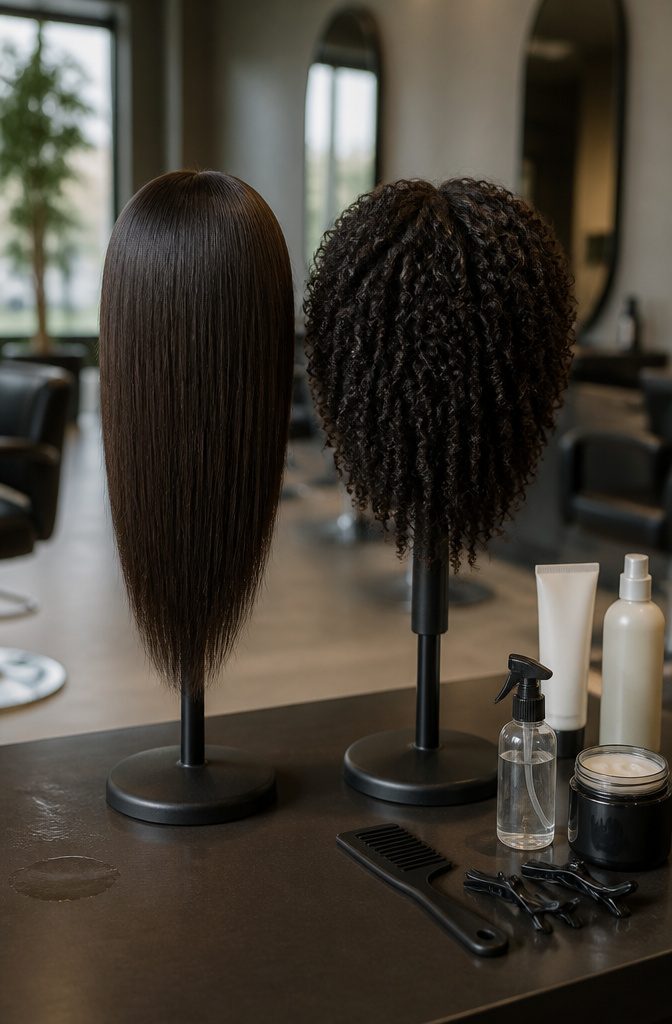
Curl pattern varies widely within any population, and ethnicity alone cannot determine whether someone has type 1, 2, 3 or 4 hair. I’ve seen sources note that the straight-to-coily chart describes physical structure, not ancestry, and that any pattern can appear in any group.
The categories also do not differ by sex. Men and women share the same type system.
The difference shows up in styling and care choices rather than in the hair itself. Men often keep shorter styles, which can make texture easier to manage day to day.
Women may explore longer looks, protective hairstyles or layered cuts depending on their type, but the underlying pattern follows the same 1A through 4C framework either way.
When the Chart Does Not Match What You See
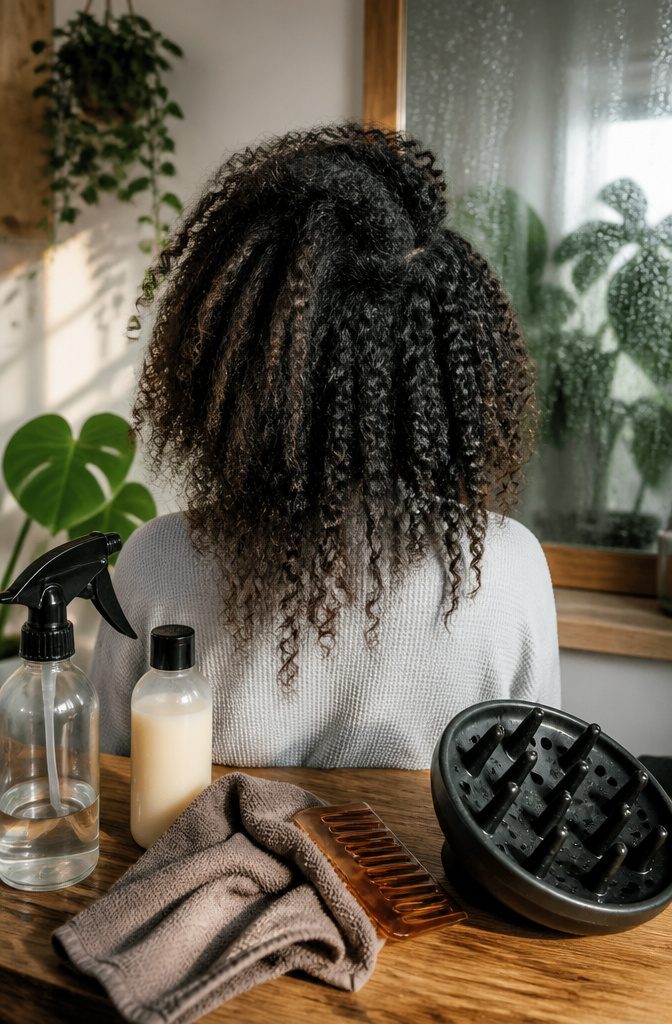
The chart is a starting point, not a fingerprint.
Curly hair specialist Jasmin Todd puts it plainly: no curl is the same, and every head is as unique as a fingerprint. Two people who both land on 3B can find their curls behave in completely different ways.
The standard categories do not cover every possible texture, and they leave out density, strand thickness, and porosity, all of which affect how hair responds to product and styling.
Some curl types seem to be treated as more desirable than others when you look at how the chart is discussed, though NaturAll and wikiHow both note that no category is inherently better.
The chart also does not account for temporary shifts: styling, humidity, product buildup, heat, or chemical damage can all change how your pattern looks day to day.
Longer-term changes happen with aging, hormonal shifts, and medications. If what you see does not match the chart, the chart is incomplete, not your hair.
Frequently Asked Questions
What is a hair type chart?
A hair type chart is a classification system that groups hair by visible curl pattern, running from straight (Type 1) through wavy (Type 2), curly (Type 3), and coily (Type 4), with letter subdivisions A through C marking tighter patterns within each numbered type.
Andre Walker developed the most widely used version in the 1990s. The chart gives you a shorthand for identifying pattern and choosing products, though porosity, density, and strand thickness matter just as much for how hair actually behaves.
How do I figure out my hair type?
Wash your hair and let it air-dry completely without products, heat, or styling tools, then compare what you see to a 1A–4C chart.
Check several areas of your head rather than one spot, because different sections can show different patterns. If your hair has been chemically treated or heat-styled regularly, what you see may not reflect the natural pattern underneath.
Can you have multiple hair types on one head?
Yes, having more than one curl pattern is completely normal. The hair at your crown might be 4C while the front comes in 4B, or your hairline might wave differently than the back.
When that happens, identify the pattern that covers the largest area and adjust product amounts or methods for other sections rather than running a separate routine for each.
How is hair type different from hair texture?
Hair type describes the curl pattern (straight, wavy, curly, coily), while hair texture describes the diameter of individual strands (fine, medium, coarse).
You can have coily hair that is fine-textured, or straight hair that is coarse-textured. Texture affects how products sit and how much weight your hair can carry, separate from what the curl does.
Does hair type change over time?
The visible pattern can shift temporarily because of styling, humidity, product buildup, heat, or chemical damage, and longer-term changes can accompany aging, hormonal shifts during puberty, pregnancy, or menopause, and certain medications.
To tell whether a change is lasting, observe clean, air-dried new growth rather than only the processed lengths. If the shift is sustained or comes with shedding or scalp discomfort, consult a dermatologist.
What is the difference between 4B and 4C hair?
Type 4B commonly forms tight bends or a Z-shaped pattern, while 4C is similarly tight but its individual coils may be harder to distinguish without styling and may show more shrinkage when dry.
Both sit at the coily end of the chart, and both need frequent moisturizing and minimal manipulation to prevent breakage.
What are the main hair types?
The 4 main pattern groups are straight (Type 1), wavy (Type 2), curly (Type 3), and coily (Type 4), with letters A through C marking tighter patterns within wavy, curly, and coily types.
Texture, density, and porosity also shape how hair behaves, so pattern alone does not tell you what products to use or how often to wash.
Why does hair porosity matter?
Porosity describes how easily your hair absorbs and retains moisture, which decides how products work. Low-porosity hair has a tightly packed cuticle, so water and conditioner sit on the surface instead of soaking in.
High-porosity hair drinks up moisture fast but loses it just as quickly, leading to dryness and frizz. Balanced porosity holds hydration without much fuss and tends to be the easiest to work with.
What is the difference between hair texture and density?
Texture is the thickness of one strand, while density is how much hair grows per square inch of scalp.
You can have fine strands with high density, which reads as thick hair overall, or coarse strands with low density that looks sparse.
Density matters for product choice because high-density hair can take richer creams without going limp, while low-density hair needs lighter formulas.
Which of the following is not a type of hair?
Hair color, length, and thickness are not the 4 texture-based types.
The chart classifies hair by pattern: straight, wavy, curly, and coily. Hair color and length are styling choices, and thickness refers to strand diameter or overall density rather than the curl pattern itself.
Is my hair 1C or 2A?
Type 1C is straight with a subtle bend near the ends and slightly more body than 1A or 1B, while Type 2A shows loose S-shaped waves that often start below the roots.
If your hair air-dries with no wave pattern and only a bend at the tips, it is 1C. If you see loose bends that form an S shape even if they are faint, it is 2A.
How many kinds of hair are there?
The standard chart includes 12 subcategories running from 1A through 4C: straight (1A, 1B, 1C), wavy (2A, 2B, 2C), curly (3A, 3B, 3C), and coily (3A, 4B, 4C).
Some versions leave Type 1 undivided, and many heads carry more than one pattern at once, so the chart is a starting point rather than a complete inventory.
How often should you wash each hair type?
Type 1 and 2A hair often need washing every 1 to 3 days because natural oils slide down straight or loose waves quickly.
Type 2B and 2C can go 2 to 5 days, Type 3 every 5 to 7 days, and Type 4 once a week or as little as once every 2 to 3 weeks.
The tighter the pattern, the harder it is for oil to travel down the strand, so coily hair needs less frequent washing and more daily moisturizing.
How do you tell what kind of curly hair you have?
Wash your hair and let it air-dry without products or heat, then look at the size and shape of the curl. Type 3A curls are 1 to 1.5 inches wide, about the diameter of sidewalk chalk.
3B curls tighten to roughly half an inch, the width of a marker. 3C curls are a quarter inch or smaller, as narrow as a drinking straw, and coil tightly from root to end.





