
A diamond face shape has cheekbones that are the widest point of the face by a clear margin, with both the forehead and jawline measuring considerably narrower.
Most hairstyles either add volume right where you’re already widest or leave the narrow zones exposed, pushing the proportions further from balanced.
The styles that work best put width at the forehead or chin: side-swept bangs, chin-length bobs with movement, and layers that frame below the cheekbones rather than at ear level.
What Makes a Face Diamond-Shaped
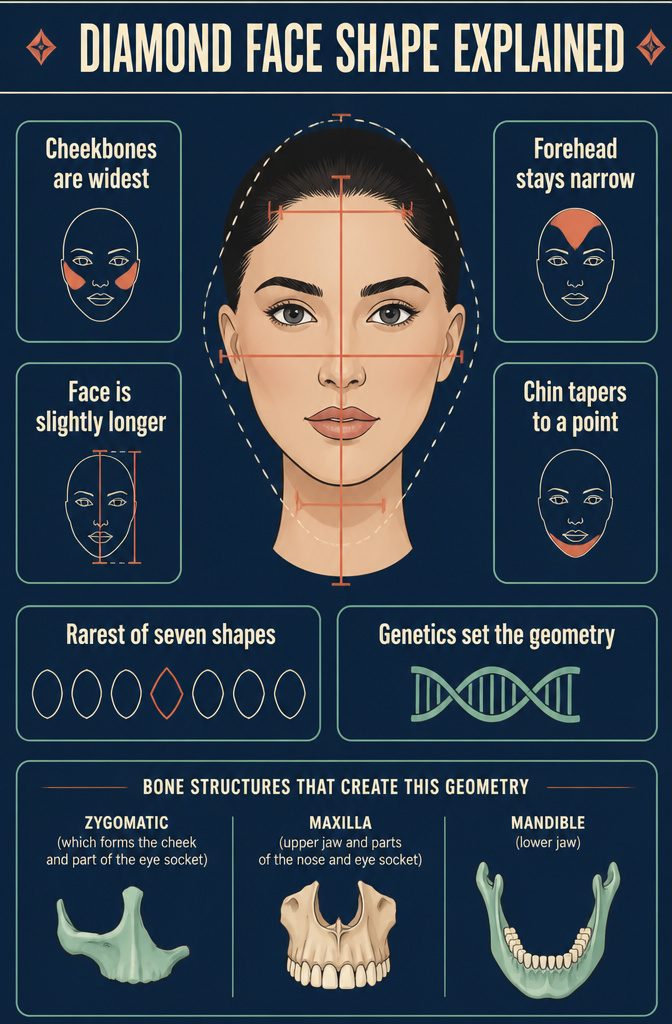
A diamond face shape has cheekbones that are the widest point by a clear margin, with both the forehead and jaw measuring considerably narrower.
The face is slightly longer than it is wide, creating a profile that is narrow at the top and bottom and prominent through the middle.
The chin tapers to a relatively pointed shape, though the angularity is less dramatic than what you see in a heart-shaped face. The forehead is narrow, often with a hairline that rounds at the edges.
The bone structures that create this geometry are the zygomatic (which forms the cheek and part of the eye socket), the maxilla (upper jaw and parts of the nose and eye socket), and the mandible (lower jaw).
Genetics determine face shape, though trauma and certain medical conditions can alter it over time. Diamond is the rarest of the seven established face shapes, making up a smaller percentage of the population compared to oval, round, or square faces.
How to Recognize It on Yourself
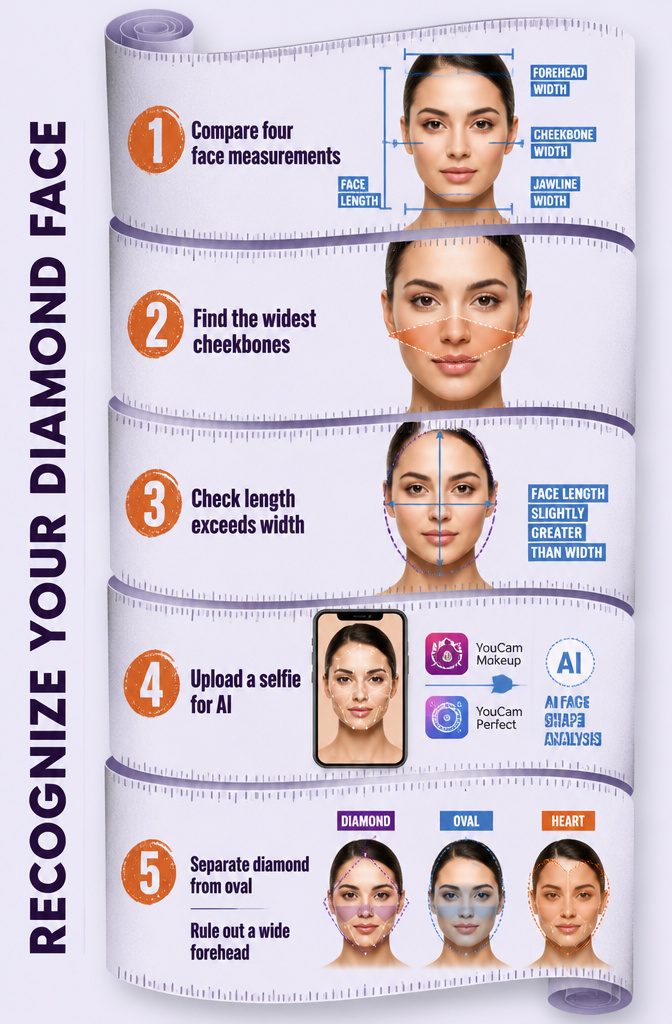
Start by comparing the four measurements that define your face: forehead width, cheekbone width, jawline width, and face length.
The diamond shape has a clear signature: cheekbones are the widest point by a visible margin, and both forehead and jaw are considerably narrower.
Face length is slightly greater than width, giving the whole shape a vertical quality. The cheekbones sit high and project far beyond the forehead and chin, creating that narrow-top, wide-middle, narrow-bottom silhouette.
If you want a second opinion beyond the mirror, YouCam Makeup and YouCam Perfect both offer AI face-shape analysis.
Download the app, upload a selfie, enter a prompt asking for face shape analysis, and let the AI measure your proportions. YouCam’s AI is built to work across diverse skin tones and ethnicities, analyzing bone structure rather than specific features.
Diamond gets confused with oval and heart most often. Oval faces have cheekbones as the widest point too, but all four measurements taper gradually and proportionally.
Heart faces have a wide forehead, not narrow. Diamond cheekbones project much farther beyond the forehead and jaw than oval cheekbones do, and that extreme mid-face width is what you’re looking for.
The Balance You’re After
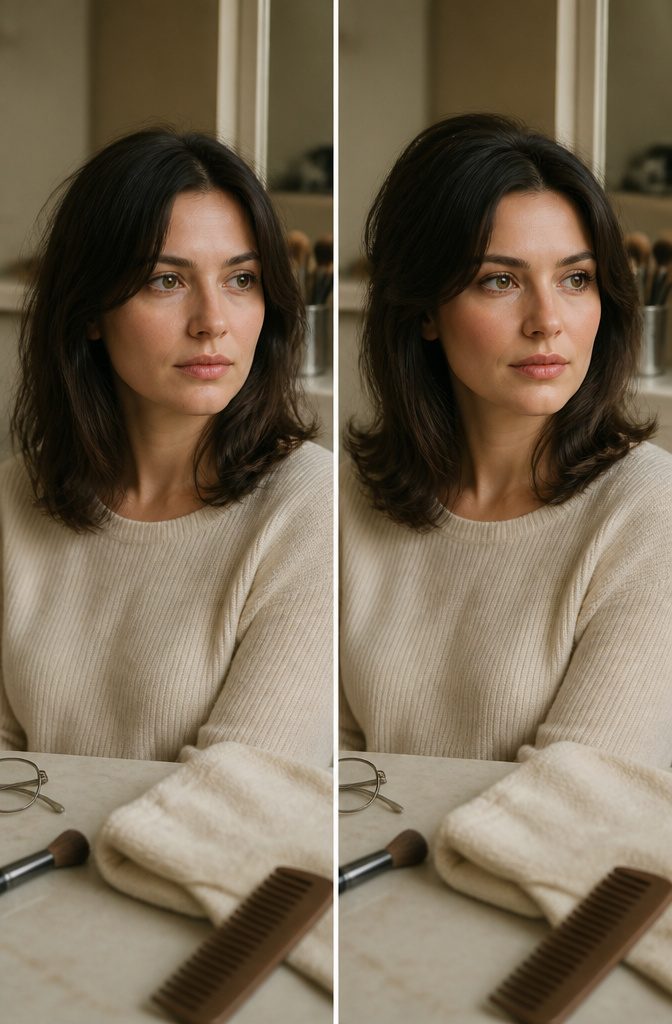
You want to add width at the forehead and chin while keeping volume away from the cheekbones.
A diamond face is narrow at the temples and jawline but widest at cheekbone level, and directing fullness toward those already-broad points can make the proportions read more extreme.
The move that balances things is simple: styles that bring softness or volume to the forehead or jaw area, and keep hair closer to the head at ear level where the cheekbones flare.
Some approaches highlight the cheekbones deliberately, treating them as the feature to frame rather than manage.
Others aim to soften their prominence by redistributing visual weight. Both work, and the choice depends on whether you want the angles to be the first thing someone notices or prefer a more oval-leaning balance overall.
This principle carries beyond hair. Contouring, glasses frames, earring shapes, and hat brims follow the same logic: widen the narrow zones, keep decoration and volume away from mid-face width.
Side-Swept and Curtain Bangs
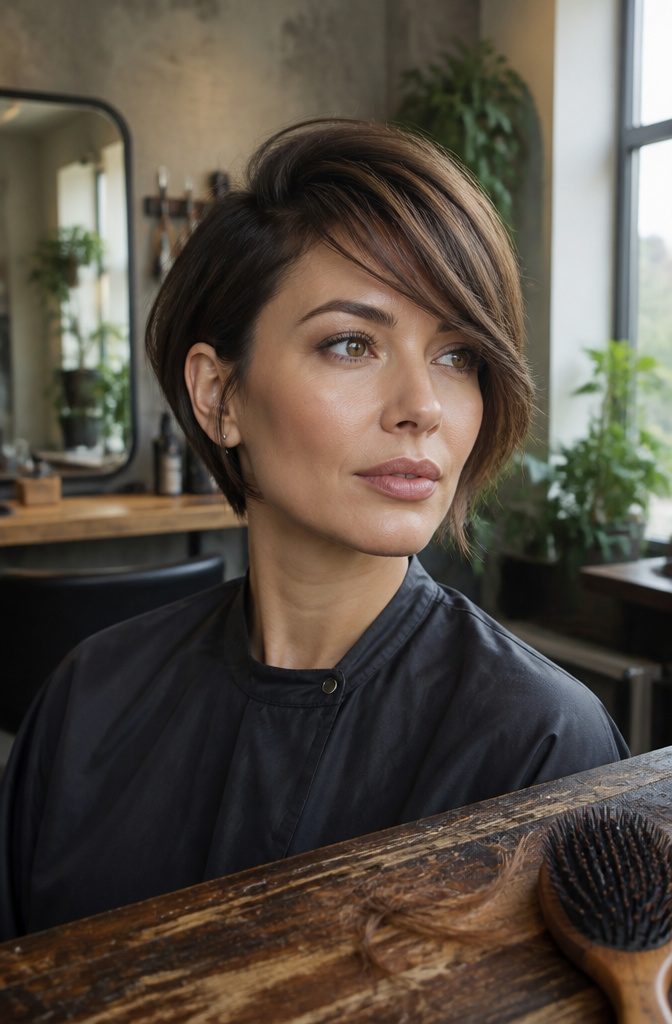
Side-swept bangs add width across the forehead without the upkeep blunt fringe demands. Start them near the cheekbones and sweep them across the forehead to break up the narrow zone and push visual weight toward the temples.
A side part works better than a center part here, since the asymmetry itself reads as width.
Curtain bangs parted at the center do similar work with less precision in the morning.
They frame the forehead on both sides and widen it optically without sitting in a straight line that needs daily attention. Both options beat blunt bangs, which most sources flag as the wrong move for diamond faces.
A straight-across fringe can make the forehead look narrower by highlighting how little horizontal distance it covers, and it draws more focus to cheekbones that already dominate the face.
Wispy or side-swept versions let you add forehead coverage without that risk.
Layered Cuts That Frame Below the Cheekbones

Layers placed below the jaw and cheekbones let you keep length without pushing fullness into the widest part of your face.
Long layered cuts work because the volume sits lower, closer to the chin and neck, which helps balance a narrow jawline instead of competing with prominent cheekbones. The layers create movement and width where a diamond face needs it.
Long straight hair without layers is one style to skip.
Hair that hangs flat from roots to ends adds no counterbalance at the lower face, and all the attention stays at cheekbone level. Layered hair, whether curly or straight, redistributes focus and adds softness below the widest point.
The cut grows out more forgivingly than blunt ends, and you get options for styling without fighting your face shape every time you tie it back.
Chin-Length Bobs With Movement
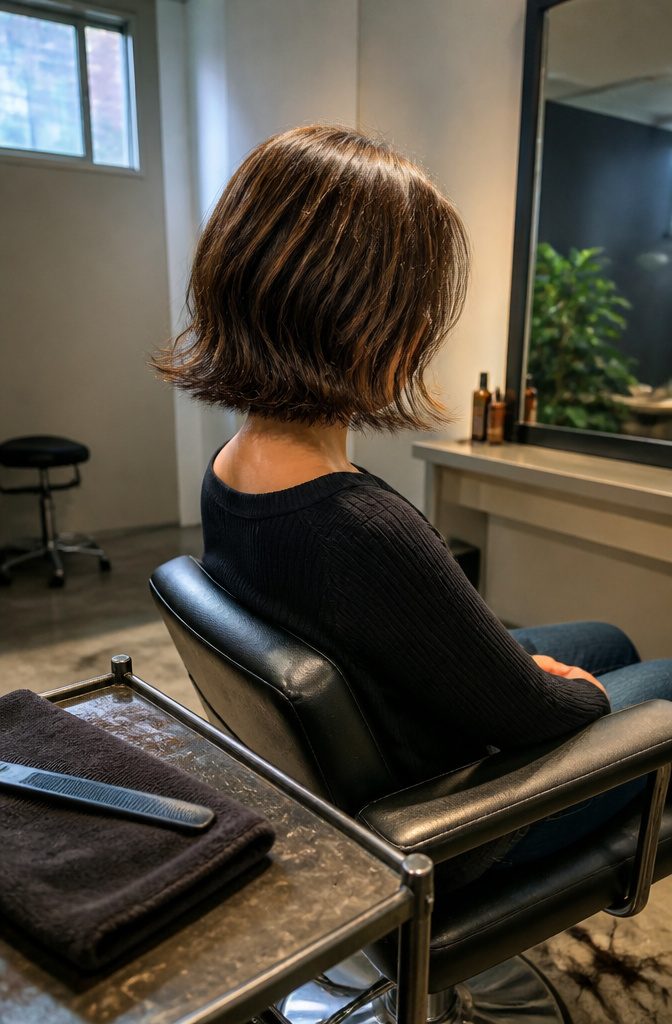
A chin-length bob sits right where a diamond face needs width. Point-cut ends with a slight outward flare at the chin add horizontal dimension through texture rather than weight, and that textured, feathered finish spreads outward instead of falling straight.
Ask for point-cutting at the ends if you book with a stylist; the technique creates movement that reads as width at chin level.
Softly waved bobs work better than sleek ones here. The wave puts volume and motion exactly where the diamond shape tapers, and movement keeps the cut from clinging to the jawline.
Short hair suits a diamond face when it has enough body to balance the cheekbones, and a bob with texture delivers that without adding length you may not want.
Shoulder-Length Waves and Volume at the Crown
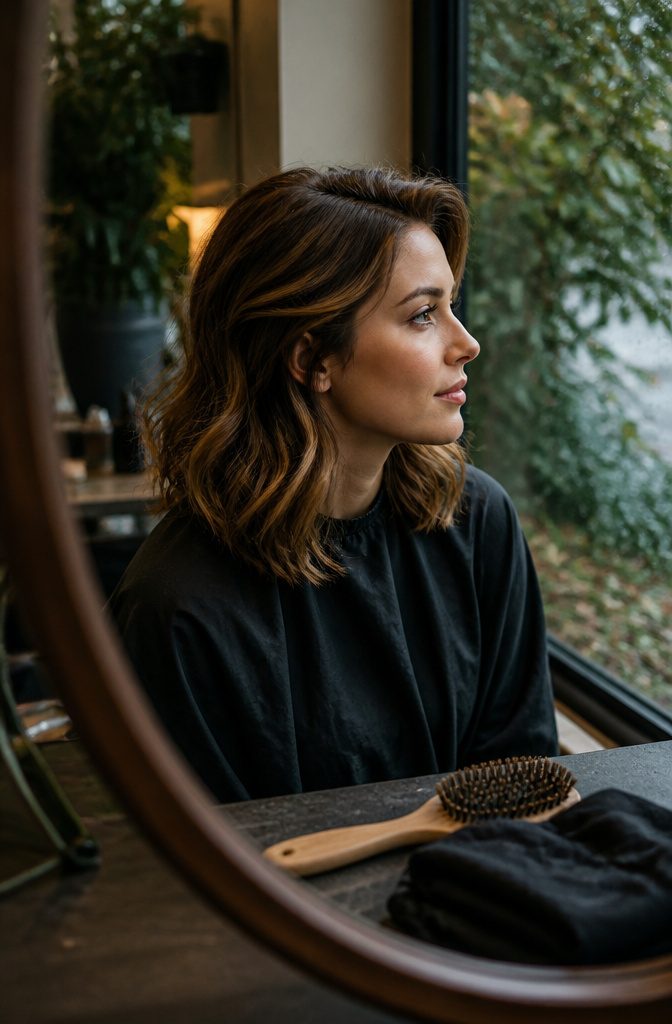
Shoulder-length waves put volume right where a diamond face needs it most: at the crown and through the mid-lengths, rather than across the widest part of the cheekbones.
The shape benefits from width at the top to balance the narrow forehead, and waves that start below the temples soften the angles without adding bulk at cheek level.
A center or slight off-center part keeps the crown lifted, and the length grazes the collarbone so the ends sit past the point where the face is widest.
Crown-volume pixies work on the same principle.
Texture and height at the top bring presence to the upper third of the face, and keeping the sides tapered or close means the silhouette widens where you want it to and stays narrow through the cheekbone zone.
Both cuts redirect attention upward and away from the place a diamond shape is already angular.
Soft Updos With Face-Framing Tendrils

A loose chignon or messy bun pulls your hair up and off your shoulders without adding to the angles you’re trying to soften.
The move that makes either one work for a diamond face is leaving a few face-framing tendrils loose at the temples and along the jawline.
Those pieces add a bit of width exactly where a diamond face is narrowest: at the forehead and the lower third of the face.
The softness balances the cheekbone width without covering it entirely. A side-swept updo does the same thing, especially when a few pieces fall forward on one side.
The tendrils can be curled lightly or left straight, depending on whether you want more texture or just a little intentional looseness around the face.
What to Skip
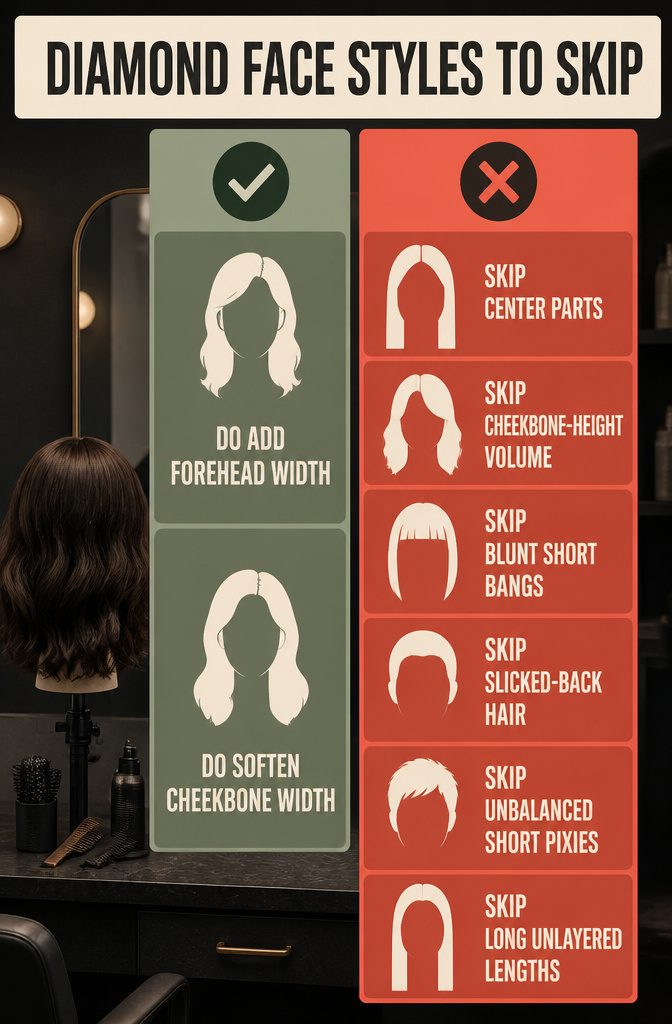
A few choices make diamond faces look narrower at the forehead or wider at the cheekbones, both of which push the shape further from balanced:
- Center parts — hair falling straight down on either side of a center part adds no width at the forehead and can frame the cheekbones, making that zone look even broader.
- Volume or fullness at ear or cheekbone height — adds width exactly where the face is already widest, making the diamond shape more pronounced.
- Blunt or very short bangs — heavy straight-across bangs shorten the forehead and draw attention to the cheekbones rather than softening them.
- Super sleek, slicked-back styles with no face-framing strands — expose the narrow forehead and highlight the cheekbones with no coverage or balance.
- Very short pixie cuts without crown volume or fringe — leave the forehead exposed and do nothing to offset the cheekbone width.
- Long straight hair with no layers below the jaw — hangs straight down without adding any balancing width at the forehead or chin.
Makeup and Contouring for Prominent Cheekbones
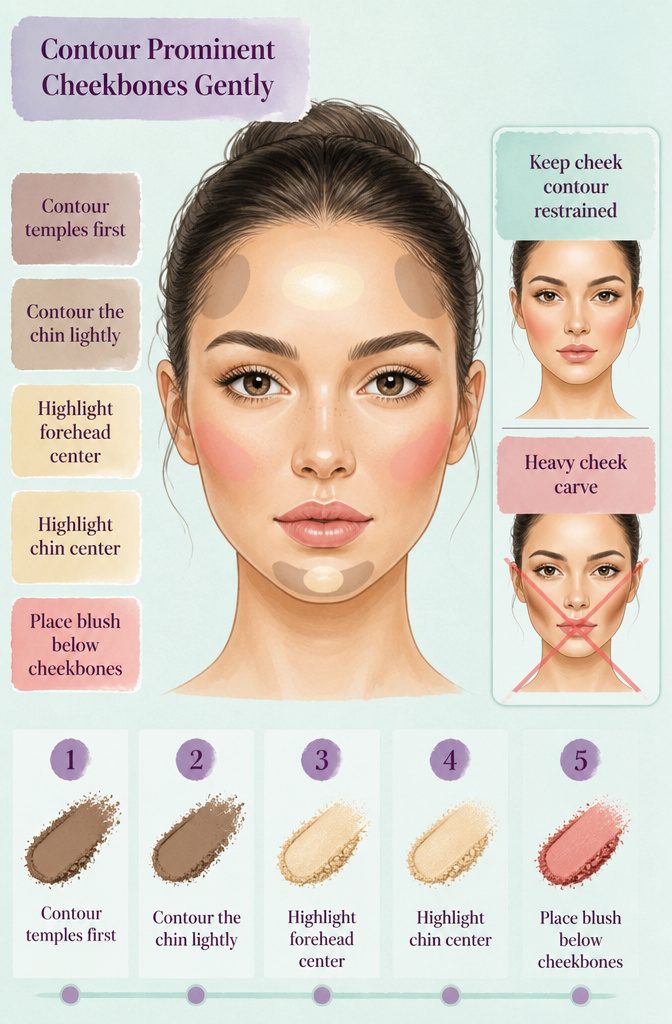
Your cheekbones are already doing the work. The contour they need is restrained or none at all, because diamond faces start with prominent cheekbone structure and heavy contouring makes the width difference between cheekbones and forehead even more dramatic.
Instead, target the narrow zones: contour the temples and chin to soften those points, then highlight the center of the forehead and chin to draw light inward.
Blush goes slightly below the cheekbones rather than on top of them, adding warmth without pushing width outward. I find it helps to think of this as building up the forehead and chin rather than carving out the cheeks.
Use a light hand and a matte product if you contour the cheekbone area at all. You want subtle structure, not the heavily sculpted look meant for oval or round faces.
Glasses That Soften the Angles

Cat-eye frames add width at the temples through their upswept corners, which directly compensates for the narrow forehead that defines this shape.
Oval frames work when they sit at or slightly near cheekbone width, spanning the broadest part of your face without adding emphasis.
Rimless and semi-rimless styles place minimal visual weight on the cheekbones while still contributing structure at the brow line.
Frames with decorative brow bars or top-rim detail pull attention upward and add perceived width to the forehead.
Geometric frames in hexagonal or octagonal shapes introduce defined angles that contrast with the curves of your cheekbones and create structure at the brow zone.
You will find conflicting advice on width: some recommend frames at or slightly wider than your cheekbones, others no wider. Round glasses can work if the frame edges land at or just outside cheekbone width.
Two-tone frames soften the look further. Warm tortoiseshell on the upper rim with a translucent or lighter lower half distributes visual weight toward the forehead.
Warm gradient lens tints in amber or rose add the same effect. Update glasses every two or three years, and skip visible bifocals in favor of no-line progressive lenses.
Hair Color Placement That Distributes Attention
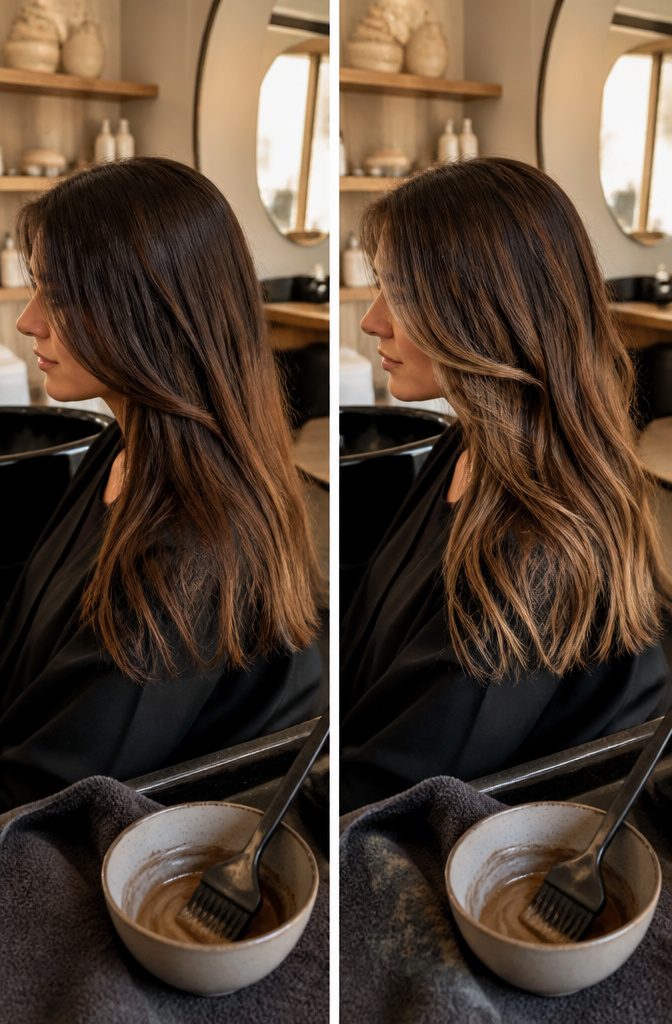
Color placement can pull the eye along the perimeter of your face instead of letting it stop cold at the cheekbones.
Balayage and face-framing highlights do that work best because the color moves where you need the movement: sweeping along the jawline, grazing the temples, breaking up the hard vertical line from cheek to chin.
Sun-kissed blondes, caramel browns and honey tones keep the contrast soft enough that the shape reads as balanced rather than sectioned.
Ombre works differently but lands in the same place. The gradual shift from rich warm browns into golden hues, or dark blondes fading into platinum, adds dimension without the hard line a single-process color leaves behind.
The fade distributes attention down the length of the hair instead of pinning it all at the widest point of your face.
YouCam’s Hair feature lets you try both the cut and the color at once, so you can see whether the placement actually does what you need it to before you sit down in the chair.
Earrings and Hats

Earrings that widen toward the bottom pull attention down and balance the narrow chin that defines this shape.
Tear drops, pear shapes, ovals, triangle shapes, and chandelier earrings all do this, narrower at the top and fuller below. Skip studs and anything that stops at the widest part of your cheekbone.
For hats, look for full shapes with large brims worn farther back on your head rather than pulled low across your forehead.
Shallow crowns work better than deep ones. The practical ceiling on brim width is your shoulder line: never wider than your shoulders, or the proportions tip into mushroom territory.
Floppy hats tend to fail for the same reason, collapsing in ways that exaggerate width where you already have it.
Options for Men
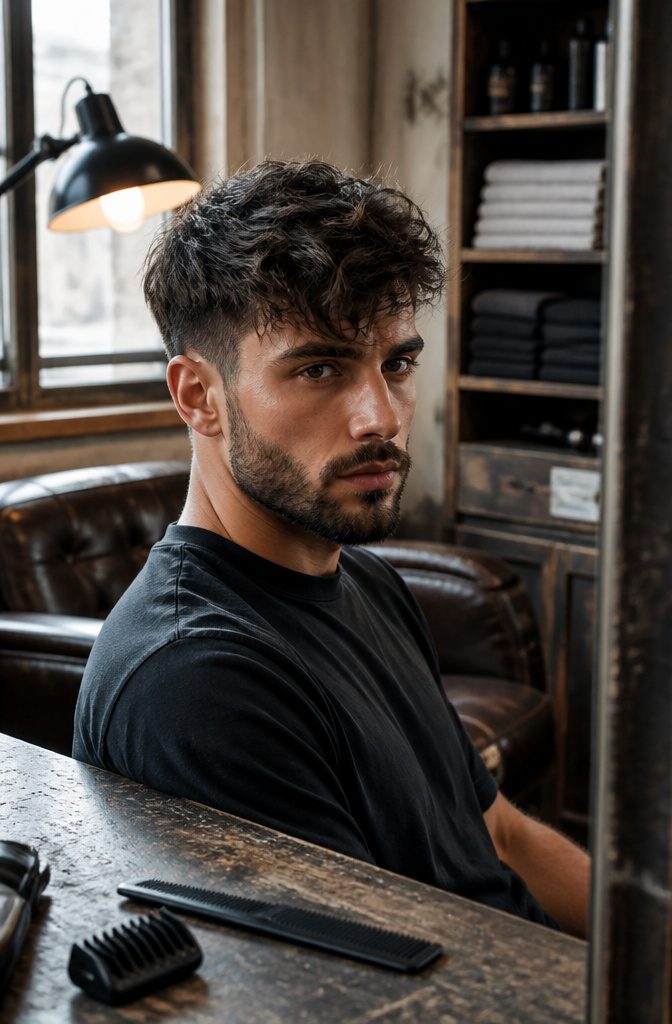
The structural principle is the same: add width at the narrow forehead and chin, reduce any emphasis at the widest part of the face.
For hair, that means volume at the crown paired with tapered sides that keep bulk away from cheekbone height.
A textured fringe pushed forward and slightly to the side adds coverage where the forehead narrows, and the side angle breaks up the symmetry.
A side part with forward fall works the same way, increasing apparent width at the top third of the face.
Medium length with texture throughout gives flexibility to direct volume upward without letting hair sit flat against the sides at the cheekbones.
For beards, you want fullness at the chin and lower jaw. A full beard adds width where the face needs it most.
A well-shaped goatee or rugged stubble works if a full beard is not your preference. A short boxed beard kept at 1–2 cm, with density concentrated at the chin, is the strongest choice.
Keep the cheek line lower, closer to the jawline, rather than allowing the beard to ride high on the cheeks and add bulk where the face is already wide.
Posing and Lighting for Photographs
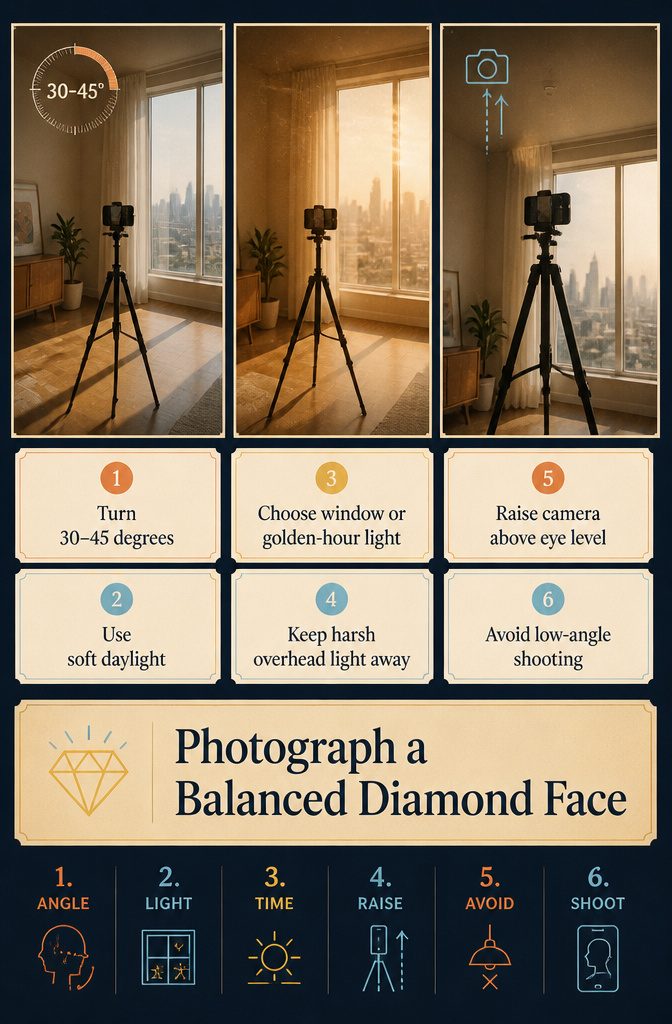
I turn my head about 30–45 degrees to the side when I shoot selfies or ask someone else to take a photo.
That slight angle pulls attention away from the widest part of the face and keeps the cheekbones from dominating the frame. Straight-on shots tend to emphasize width right where a diamond face is already broadest.
Soft daylight makes the biggest difference.
I look for window light or shoot during golden hour, and the diffused glow softens angular features instead of carving them deeper the way harsh overhead bulbs do. The warmth adds dimension without throwing hard shadows across the cheekbones.
Camera height matters more than most people expect. Shooting slightly above eye level highlights the eyes and temples while the jawline reads narrower.
Very low angles do the opposite, pulling focus down to the chin and making the lower third look heavier than it is. A foot or so above eye level usually balances the whole face in the frame.
Celebrities With This Shape

Celebrities With This Shape
Halle Berry, Jennifer Lopez, Rihanna, Megan Fox, Scarlett Johansson, Beyoncé, Tyra Banks, Serena Williams, Brandy, Vanessa Hudgens, and Kate Bosworth all share diamond face structure, along with Johnny Depp and Robert Pattinson.
The range matters because it shows how different hair textures, lengths, and styling choices all work with the same underlying geometry.
Rihanna softens her cheekbones with layered curls or side bangs. Megan Fox pulls off sleek hairlines paired with contouring.
Robert Pattinson balances his sharp jawline with tousled texture and a slightly longer top. If you are unsure whether your face reads as diamond, oval, or heart, the cheekbone-to-forehead and cheekbone-to-jaw ratios distinguish them precisely.
Frequently Asked Questions
What is the rarest face shape?
Diamond is the rarest of the 7 established face shapes, making up a smaller percentage of the population than oval, round, or square. Genetics determine face shape, though trauma and certain medical conditions can alter it over time.
How do you know if you have a diamond face shape?
Cheekbones are the widest point by a visible margin, with both forehead and jaw measuring considerably narrower.
Face length is slightly greater than width, and the chin tapers to a relatively pointed shape. You can compare your 4 measurements (forehead width, cheekbone width, jawline width, and face length) or use an AI face-shape analysis tool like YouCam Makeup.
Can short hair suit a diamond-shaped face?
Yes, especially with volume and movement. A chin-length bob with point-cut ends and a slight outward flare at the chin adds width where you need it, and a crown-volume pixie with texture at the top balances the narrow forehead.
Avoid super sleek, tight styles or blunt bangs that emphasize the cheekbones.
Do blunt bangs work on a diamond face?
Blunt bangs are usually the wrong move for diamond faces.
A straight-across fringe can make the forehead look narrower and draws more focus to cheekbones that already dominate the face. Side-swept or curtain bangs add forehead coverage without that risk.
How is diamond different from oval if both have prominent cheekbones?
Diamond cheekbones project much farther beyond the forehead and jaw than oval cheekbones do.
Oval faces have cheekbones as the widest point too, but all 4 measurements taper gradually and proportionally. Diamond faces have extreme mid-face width with a much more dramatic ratio.
Can diamond faces wear round glasses?
Yes, if the frame edges land at or just outside cheekbone width so the cheekbones sit within the frame rather than projecting past it.
Cat-eye or geometric frames are usually stronger choices because the brow-level detail compensates for the narrow forehead.
Should I contour my cheekbones if I have a diamond face?
Use restrained contouring or none at all.
Your cheekbones are already prominent, and heavy contouring makes the width difference between cheekbones and forehead even more dramatic. Instead, contour the temples and chin to soften those points, then highlight the center of the forehead and chin.
What frame shape for diamond face?
Cat-eye frames add width at the temples through their upswept corners, which compensates for the narrow forehead.
Oval frames work when they sit at or slightly near cheekbone width, and rimless styles place minimal visual weight on the cheekbones. Frames with decorative brow bars or top-rim detail pull attention upward and add perceived width to the forehead.
What makeup style suits diamond face shape?
Target the narrow zones instead of the cheekbones.
Contour the temples and chin to soften those points, then highlight the center of the forehead and chin to draw light inward. Apply blush slightly below the cheekbones rather than on top of them, adding warmth without pushing width outward.