Full curtain bangs pull from a wider section at the front than wispy versions, creating a thicker, more statement-making fringe that sits center-parted and gradually longer toward the sides.
The style works best when your stylist examines your hairline dry first: a strong cowlick at the front will split the curtain down the middle no matter how it’s cut, and that single check prevents most bang regret.
What Full Curtain Bangs Are
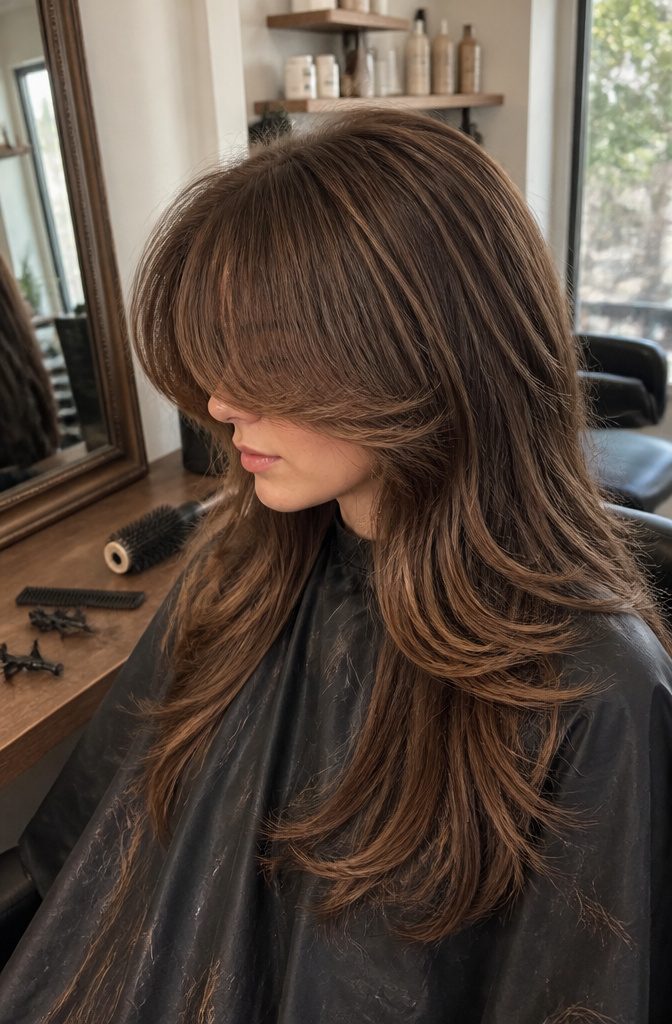
Curtain bangs are center- or slightly off-center-parted fringe that is shorter in the middle and gradually longer toward the sides, framing your face the way fabric drapes open.
The shape blends into the rest of your hair rather than stopping at a hard line, which makes it softer than blunt bangs and easier to grow out.
Full curtain bangs use more hair than wispy versions, pulling from a wider section at the front to create a thicker, more statement-making fringe.
The original style from the 70s was built this way, designed for drama and volume rather than the barely-there boho look. If you want something people notice, full is the version to ask for.
1. Face Shape, Hair Type, and Whether Full Curtain Bangs Suit You
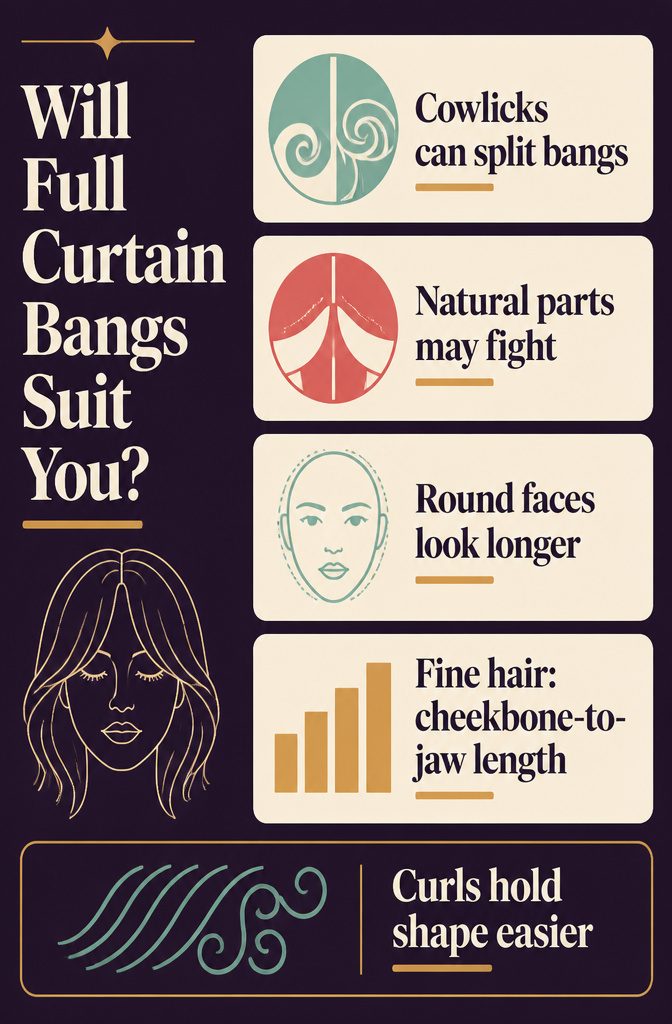
The biggest obstacle is not face shape but your hairline and how your hair naturally wants to move.
A strong cowlick at the front will split full curtain bangs down the middle no matter how you cut or style them, and a forceful natural part does the same.
I look at those dry during a consultation, watch where the hair wants to go, and can tell in two minutes whether the cut will cooperate or fight you every morning.
Sometimes curtain bangs work where a full fringe would pop apart by lunch.
Face shape matters less than most think, but full curtain bangs do flatter round faces by elongating, square faces by softening sharp jawlines, and heart-shaped faces by balancing forehead width with the chin. Oval faces handle any variation without issue.
Fine or thinning hair suits cheekbone-to-jaw length better than very short or very long curtain bangs, which may not hold their shape. Light layers help create movement.
Softer fringes tend to flatter more with age than heavy, blunt-cut options. Straight hair can sit too close to your face and needs styling to sweep, while curls and waves hold the curtain shape with less effort.
2. Choosing the Length and Fullness
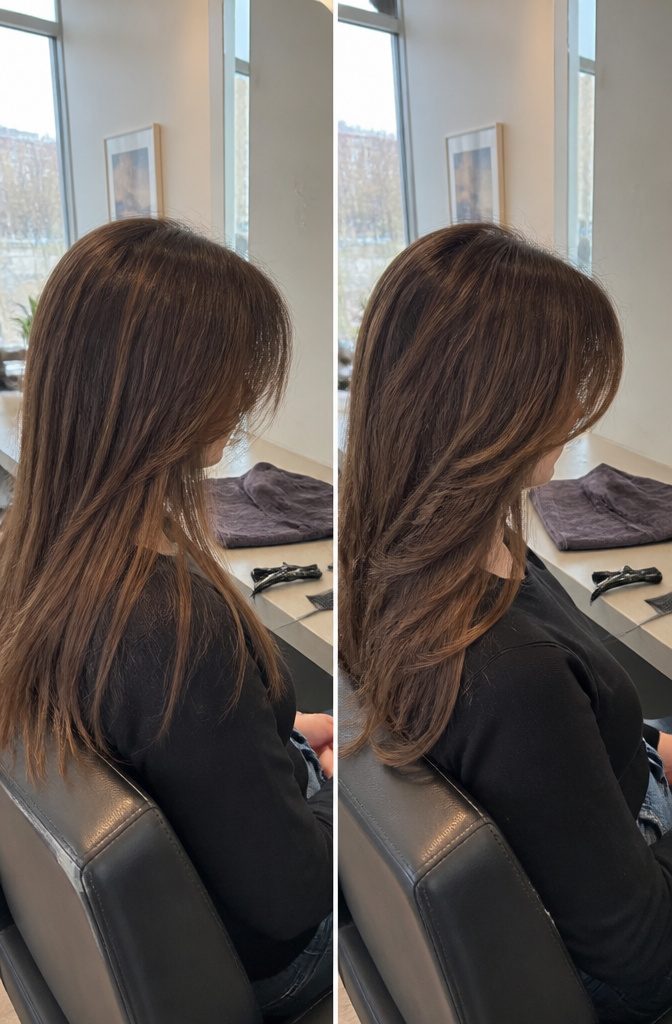
The range runs from brow- or eye-grazing styles down to versions that reach the cheekbone, jaw, or chin.
Stylists often start around the tip of the nose and cut gradually toward the cheekbones, adjusting from there based on what the hair does and what the face needs.
Shorter curtain bangs sit closer to traditional fringe territory but with the signature center part; longer ones blur into face-framing layers and need hair below the shoulders to keep the proportions balanced.
Without that length, long bangs can weigh down the face instead of opening it up.
Fuller bangs suit hair that already has depth and layers. If your hair is thick or has plenty of existing movement, a denser curtain bang pulls from that body rather than sitting flat.
Straighter, finer hair tends to cling to the face, so a fuller set risks looking heavy unless you’re willing to style it away each time.
The fullness you can handle depends less on preference and more on what your texture will cooperate with.
3. Getting the Cut Right With Your Stylist
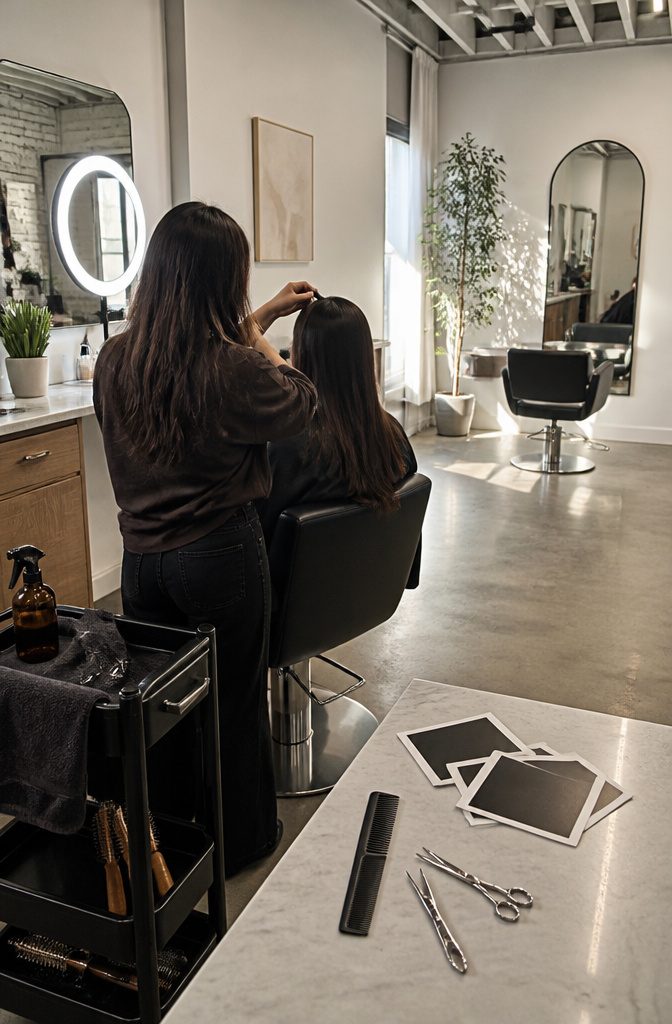
Book an in-person consultation and bring reference photos. Your idea of full curtain bangs might differ from your stylist’s, so images keep the request concrete.
During that appointment, be ready to discuss length (brow-skimming or cheekbone-sweeping), blending (merged into face-framing layers or standing alone), and thickness (full and voluminous or lighter and airier).
If you’re unsure, ask your stylist to cut longer to start. You can always trim shorter later, but growing out a too-short fringe takes patience.
Insist that your stylist examine your front hairline dry before any water touches it.
A strong cowlick at the front hairline will split a full fringe down the middle no matter how it’s cut, and crown patterns or a forceful natural part do the same thing.
Your stylist can watch where your hairline wants to move and tell you in two minutes whether full curtain bangs will cooperate or fight you forever. That single step prevents most bang regret.
Skip the DIY cut. Kitchen scissors, cutting too bluntly, failing to blend, ignoring face shape, and cutting too short are the most common home-cutting mistakes, and bangs are precision work worth booking as a proper cut.
4. How I Style Full Curtain Bangs on Straight or Flat Hair
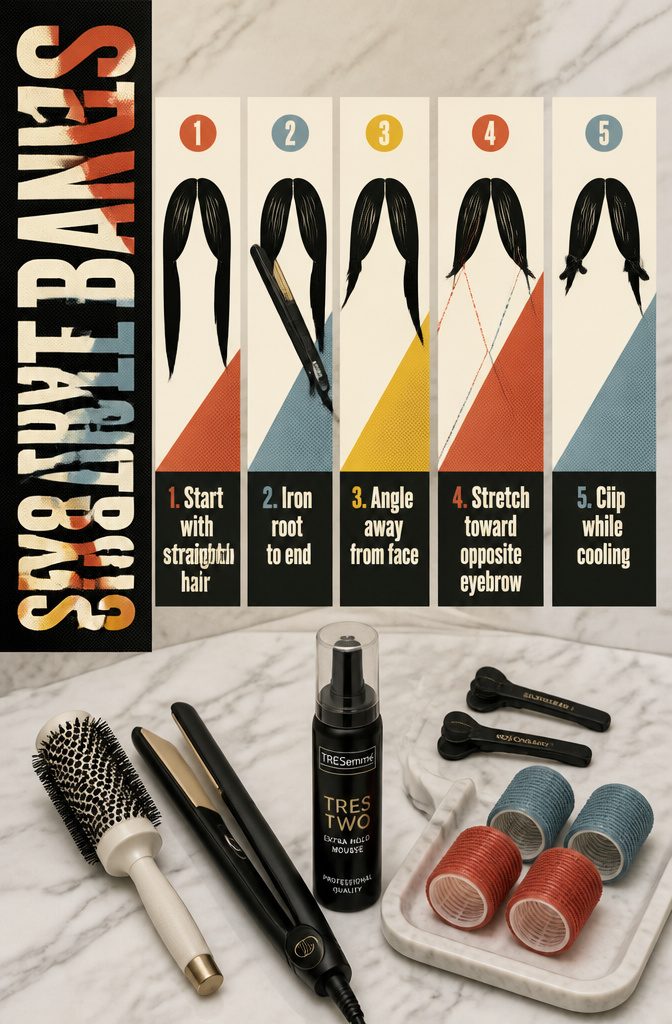
Straight hair wins the speed game here. A quick flat-iron session, one minute or less, is usually enough to set full curtain bangs in place when you start with naturally straight texture.
Run the iron from root to end and angle it away from your face so the bangs bend softly outward rather than lying flat against your forehead.
If you want more shape or your hair sits too flat at the crown, blow-dry with a round brush, lifting at the root and directing each side diagonally toward the opposite eyebrow.
That cross-angle builds volume and keeps the curtain open.
A hot brush like the GHD Rise does the same job once the rest of your hair is mostly dry, fanning the bangs out without the coordination a round brush and dryer demand at the same time.
You can rough-dry with a hairdryer (no nozzle) and, using your hands, stretch the right side diagonally toward the left eyebrow and the left side toward the right eyebrow—this will enhance the shape of the bangs.
— ELLE
That diagonal stretch works whether you use your hands or a brush, and it fixes the common problem of bangs that fall straight down the middle instead of parting cleanly.
No-crease clips hold bangs in place while they cool, which locks the shape for hours. Velcro rollers do the same thing with more lift, closer to the Claudia Schiffer volume from the nineties.
For stubborn strands or a little extra control, Tresemmé Tres Two Extra Hold Mousse at the root before drying keeps things in place without stiffness.
5. How I Style Full Curtain Bangs on Wavy or Curly Hair
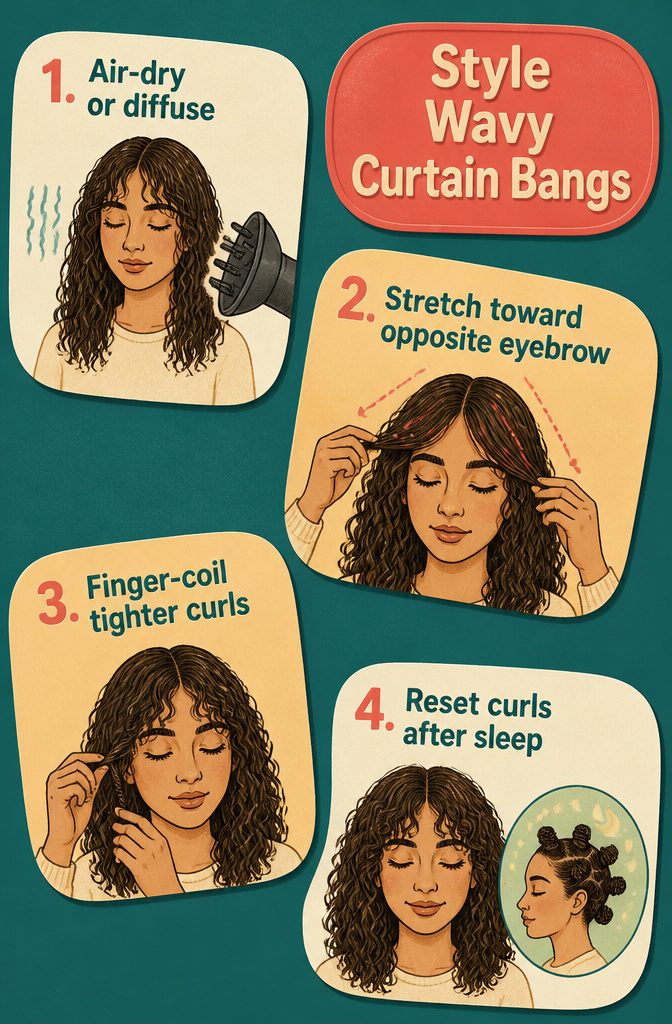
Wavy or curly hair can be air-dried or diffused to let your natural texture carry the shape.
If you diffuse, rough-dry without a nozzle and stretch the right side diagonally toward your left eyebrow and the left toward your right eyebrow to enhance the curve.
For tighter curls, finger coils or small twists set the pattern without heat, and some people use bantu knots overnight to reset the fringe every day or two.
Curly, coily, and kinky bangs do need that reset more often than straight hair, since one night’s sleep can flatten or redirect the curl entirely.
A curl-activating product like Mizani True Textures Curl Enhancing Lotion keeps definition without weighing the fringe down, and for shaggy or textured cuts, Redken Triple Dry 15 Dry Texture Finishing Spray adds grip and separation when the layers need a little mess.
6. Maintaining and Refreshing Them
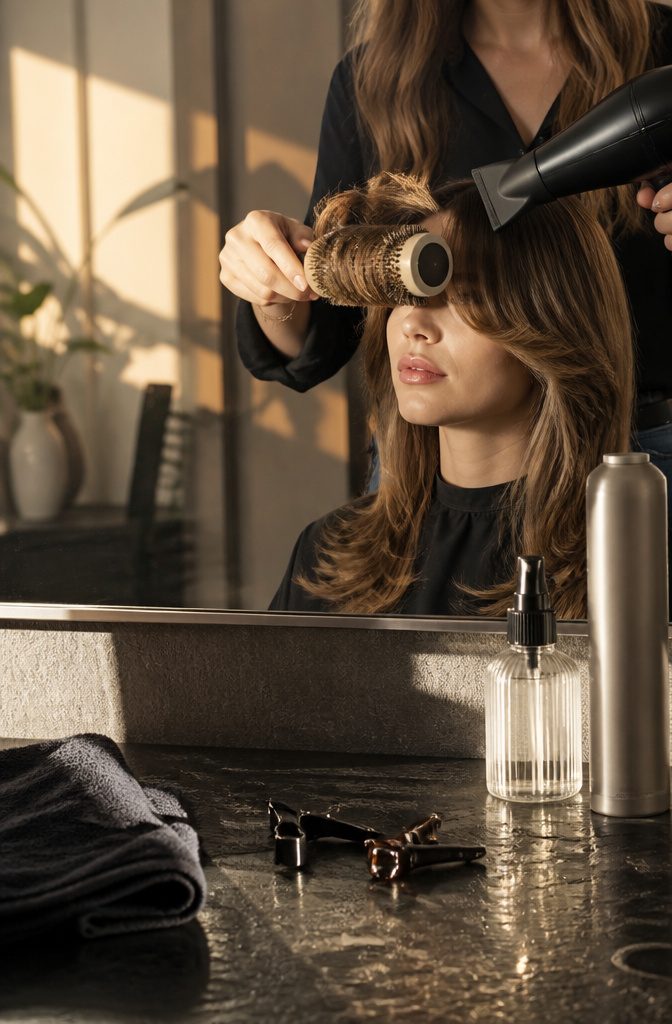
Curtain bangs are easier to maintain than blunt styles, but they still need attention. You will be back in the chair every two to six weeks for a trim if you want to keep the shape clean.
Some people find they can stretch to six weeks because the length is less precise and grows out more gracefully, while others prefer the tighter two-to-four-week window that keeps the curtain just off the brow line.
A bang trim is quick work: Reverie starts them at $10, and many salons offer something similar between full cuts.
Daily refreshing is the other half. Curtain bangs take the most heat styling per square inch of any hair on your head, so use a heat protectant every time you pick up a round brush or blow dryer.
Dry shampoo handles midweek grease without a full wash, and a styling mist resets texture on curly or wavy hair between shampoos.
Budget ten minutes most mornings unless your hair is naturally wavy enough to air-dry into the shape you want.
7. Growing Them Out or Fixing a Bad Cut
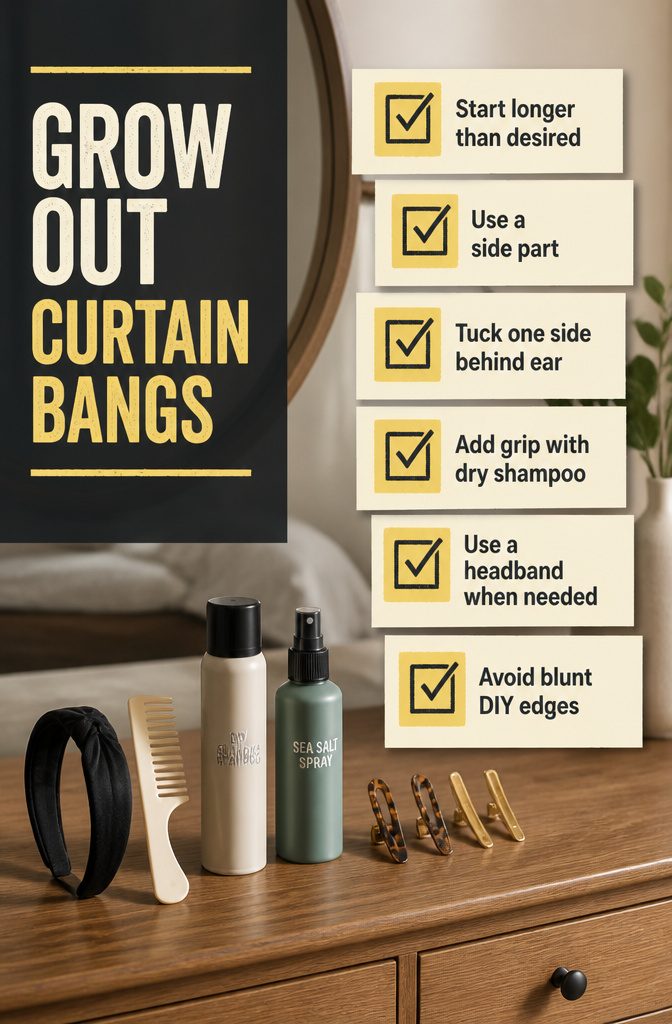
The longer sides of curtain bangs blend into layers as they grow, which means you skip the blunt horizontal line that makes most bangs look choppy three weeks in.
Growing out curtain bangs is more forgiving than growing out a blunt cut because the graduated length reads as face-framing pieces rather than an abandoned style.
A side part helps during the transition, and tucking one side behind your ear camouflages uneven lengths while you wait for the shorter pieces to catch up.
Texture products smooth the blend.
Sea salt spray or dry shampoo adds grip so the bangs sit with the rest of your hair instead of hanging separate. A headband works when nothing else does, especially if the cut was too short to tuck or pin.
Starting longer is safer because hair cannot be put back. Overly short bangs, blunt edges, or poorly blended DIY cuts are difficult to correct without waiting through several weeks of growth.
The most common mistakes are cutting too blunt and failing to shape the bangs around your face, which leaves them sitting like a separate piece instead of flowing into your layers.
Full Curtain Bangs Versus Blunt Full Bangs
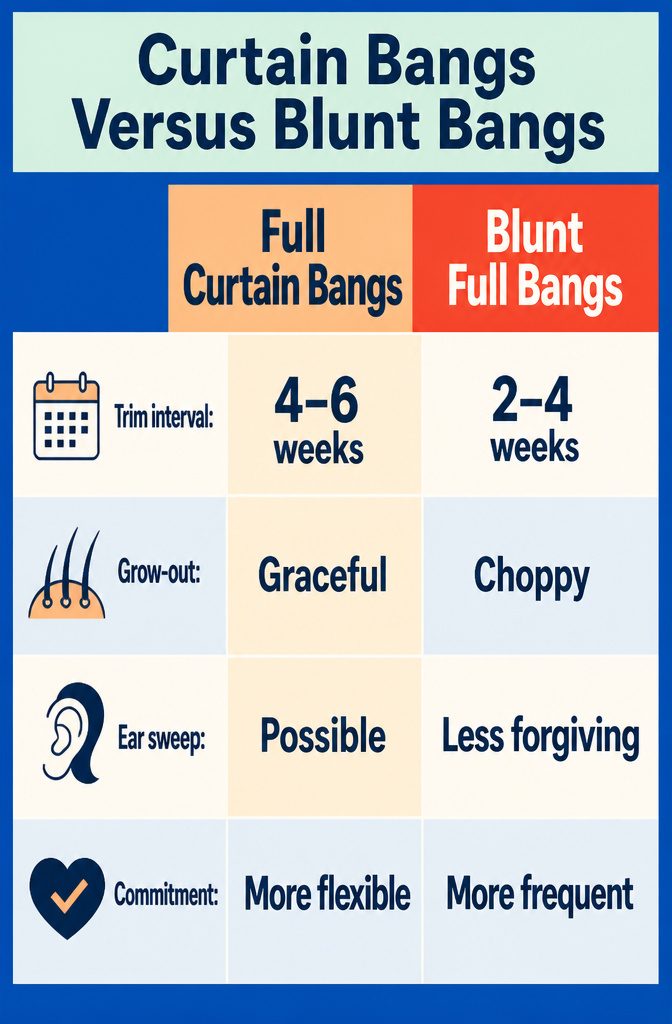
Full Curtain Bangs Versus Blunt Full Bangs
A blunt fringe makes a bolder statement and anchors a bob beautifully, but it needs maintenance every two to four weeks because a quarter inch of growth changes how it sits on your brow.
Curtain bangs are more forgiving. Since the length is less precise, they grow out gracefully over time and you can even sweep them behind your ears as they get longer.
You will still need a trim every four to six weeks to maintain the shape, but the interval is longer and the consequences of skipping it are milder.
Many salons offer quick bang trims between full cuts, often for around $10 and taking only fifteen minutes.
That helps with blunt bangs but does not solve the frequency problem, and frequency is what decides whether bangs feel like a commitment or a choice you can live with.
Full Curtain Bangs Versus Face-Framing Layers
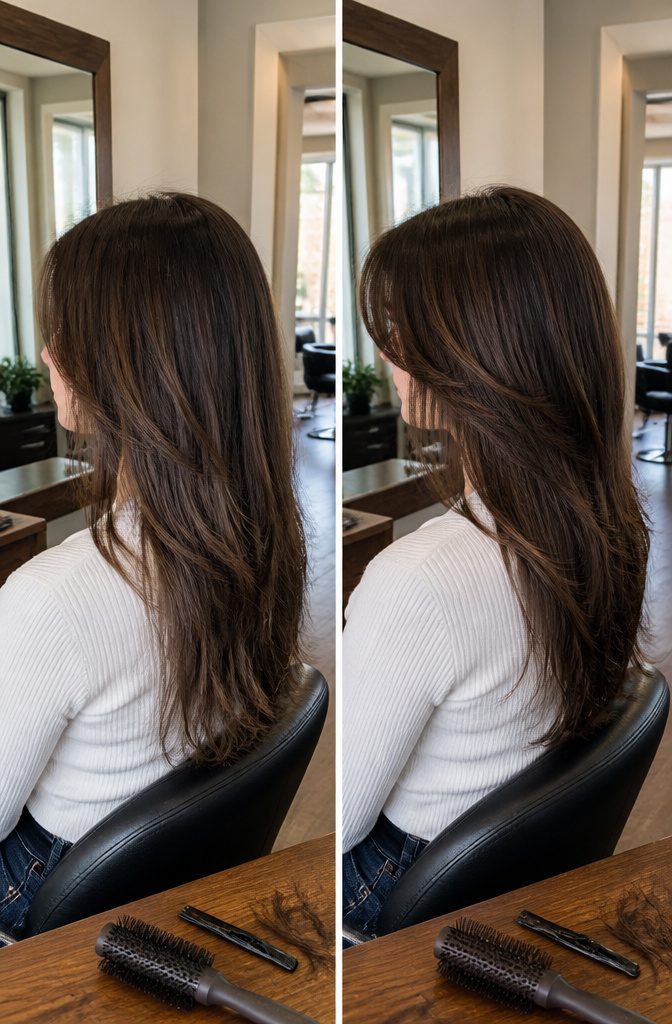
Face-framing layers taper down each side and sit at the cheekbone or lower, while curtain bangs create a shorter, more symmetrical frame that starts above the cheekbone and sweeps outward from a center or slightly off-center part.
The layers are the longer cut. Curtain bangs might be the only layer cut around the face, particularly if the rest of your hair is all one length.
The two can coexist. If you have long hair with layers already, curtain bangs sit above them and add a distinct frame.
The bangs will be styled away from your face to get that curtain effect, where longer face-framing layers just fall naturally along the jawline or collarbone.
On shorter cuts, curtain bangs often double as the face-framing layer itself, doing both jobs at once and adding volume near the root where thin hair needs it most.
Variations Worth Asking For by Name
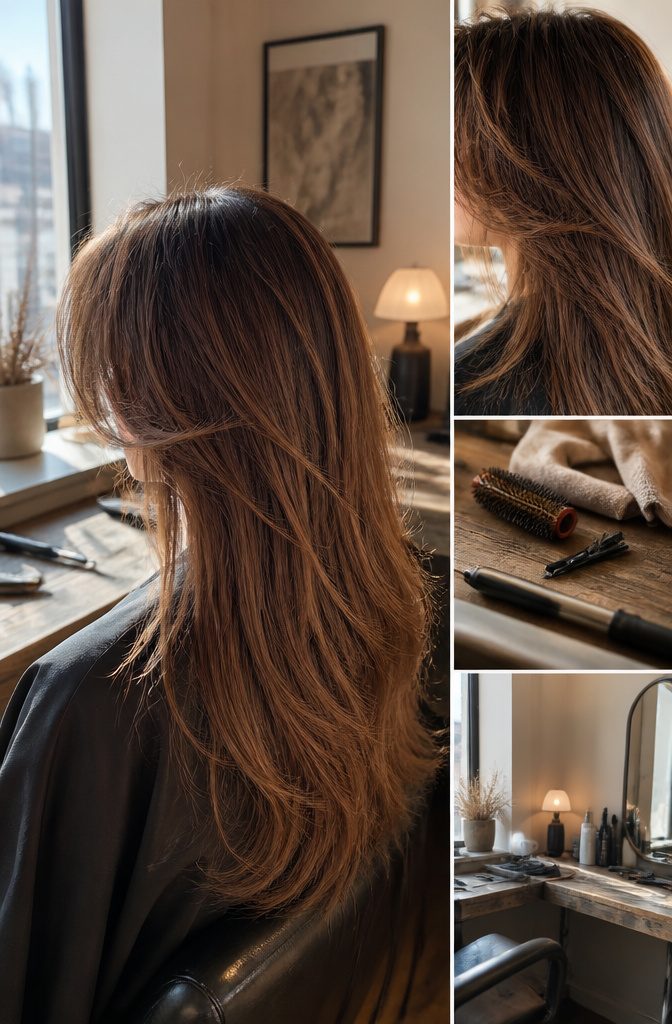
Hair.com identifies 11 curtain-bang styles, and the difference between most of them comes down to how much hair your stylist includes, how long they cut it, and how the ends are finished. A short lead-in and the variations worth naming:
Most of these land somewhere on a spectrum from barely-there wispy to full and textured. Here are the ones that show up most in styling guides and booking requests:
- Wispy curtain bangs: lighter on density, more scalp showing through, ends thinned or point-cut for separation rather than a solid line
- Layered curtain bangs: blended seamlessly into existing layers so the fringe doesn’t sit as a separate piece; lifts weight around the face and suits thick hair
- Textured or shaggy curtain bangs: choppier layers and an undone finish; works well with natural waves and curls, edgier than the soft wispy look
- Eye-grazing curtain bangs: parted down the middle and cut to sit right at the lash line, framing eyes without covering them
- Cheekbone-grazing: the classic length, hitting just above or at the cheekbone; the most universally flattering
- Long curtain bangs: extend to the jaw or lower, often just one inch shorter than the shortest layers of a bob or longer cut, making them easy to grow out or pin back
- Curly curtain bangs: fuller shape to account for shrinkage, cut longer than you think to avoid bunching when curls spring up
- Flipped-out curtain bangs: styled with a round brush or curling iron so the ends kick outward rather than curving in
Long versions work best with hair below the shoulders so the proportions don’t weigh down your face. If your hair has depth and layers already, you can go fuller without the bangs looking heavy.
Frequently Asked Questions
What are curtain bangs?
Curtain bangs are center- or slightly off-center-parted fringe that is shorter in the middle and gradually longer toward the sides, framing your face the way fabric drapes open.
The shape blends into the rest of your hair rather than stopping at a hard line, which makes it softer than blunt bangs and easier to grow out.
Full curtain bangs use more hair than wispy versions, pulling from a wider section at the front to create a thicker, more statement-making fringe.
Which face shape suits curtain bangs?
Curtain bangs flatter round faces by elongating, square faces by softening sharp jawlines, and heart-shaped faces by balancing forehead width with the chin. Oval faces handle any variation without issue.
The biggest obstacle is not face shape but your hairline and how your hair naturally wants to move, since a strong cowlick or forceful natural part will split the bangs no matter how you cut or style them.
Are curtain bangs high-maintenance?
Curtain bangs are lower-maintenance than blunt styles but still require attention.
You will need a trim every 2 to 6 weeks to keep the shape clean, and daily refreshing takes about 10 minutes most mornings unless your hair is naturally wavy enough to air-dry into the right shape.
Straight or flat hair needs more styling per square inch than wavy or curly hair, which can often be diffused or air-dried with less effort.
How to style curtain bangs?
For straight hair, blow-dry with a round brush by lifting at the root and directing each side diagonally toward the opposite eyebrow to build volume and keep the curtain open.
For wavy or curly hair, air-dry or diffuse while stretching the right side toward your left eyebrow and the left side toward your right to enhance the curve.
Use a heat protectant every time you pick up a round brush or blow dryer, since curtain bangs take the most heat styling per square inch of any hair on your head.
What is the difference between face-framing layers and curtain bangs?
Face-framing layers taper down each side and sit at the cheekbone or lower, while curtain bangs create a shorter, more symmetrical frame that starts above the cheekbone and sweeps outward from a center or slightly off-center part.
Curtain bangs might be the only layer cut around the face, particularly if the rest of your hair is all one length. The two can coexist, with curtain bangs sitting above existing layers to add a distinct frame.
What is the difference between full bangs and curtain bangs?
A blunt fringe makes a bolder statement and needs maintenance every 2 to 4 weeks because a quarter inch of growth changes how it sits on your brow.
Curtain bangs are more forgiving, with a less precise length that grows out gracefully over time and can be swept behind your ears as they get longer.
You will still need a trim every 4 to 6 weeks to maintain the shape, but the interval is longer and the consequences of skipping it are milder.