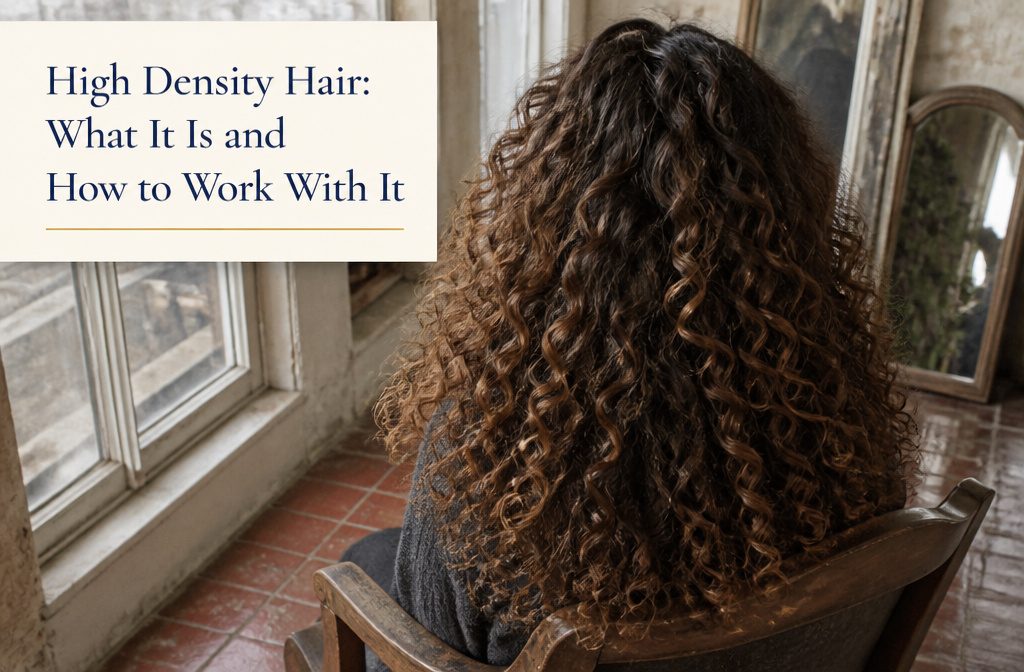
High density hair means you have 300 to 400 individual strands growing per square inch of scalp, compared to the 100 to 200 that marks average density.
That number is set by genetics and stays mostly fixed, though pregnancy, stress, thyroid disease and chemical straightening can all drop it.
A ponytail measuring 4 inches around or more usually signals high density, and it changes which products hold and which cuts flatten.
What High Density Hair Means
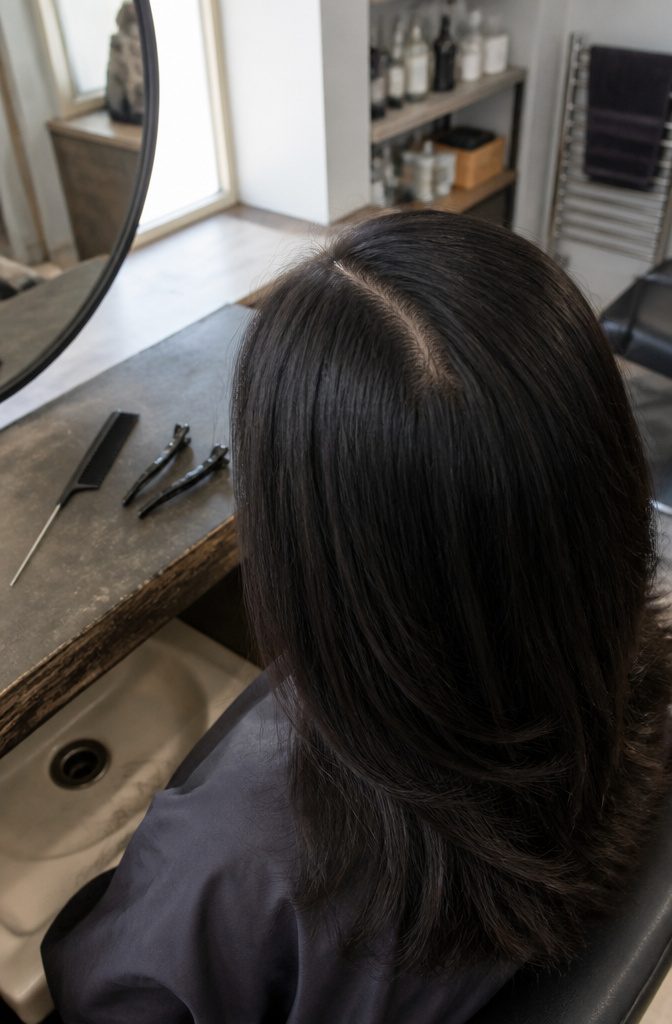
Hair density refers to how many individual strands grow per square inch of your scalp. We each carry between 80,000 and 120,000 hairs total, with average density sitting at 100–200 strands per square inch.
Some sources put the figure higher, around 2,000 strands, but the idea stays consistent: density describes how closely packed your hair is, not how thick each strand measures on its own.
High density means many strands growing close together with little scalp showing through. Where someone with low density might have 50–100 hairs per square inch, high-density hair can hit 300–400 or more in the same area.
The difference shows when you part your hair: if you barely see scalp, density is high. If scalp appears easily, it is low.
Density is inherited and fixed by the number of follicles you were born with. It tends to run highest at the crown and can shift with age, stress, pregnancy or illness, but the baseline comes from genetics rather than styling.
Density and Strand Thickness Are Different
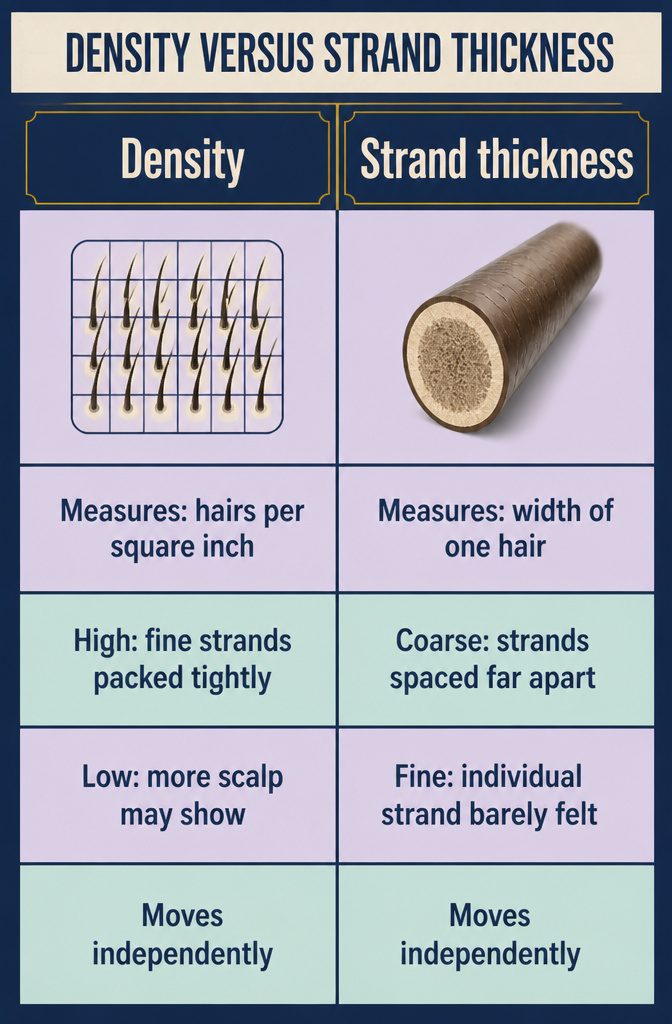
Density counts the number of hairs growing from each square inch of your scalp, while strand thickness measures the width of a single hair. You can have fine strands packed tightly together, which gives you high density hair.
You can also have coarse strands spaced far apart, landing you in the low density category. The two characteristics move independently.
The word "thick" causes confusion because it gets used both ways. Someone might say thick hair and mean coarse individual strands, or they might mean a lot of strands growing close together.
Fine does not always mean thin, and coarse does not guarantee fullness. I have seen people with fine hair surprised to learn their density is high, because the number of hairs makes up for the narrow diameter of each one.
If you can barely feel a single strand between your fingers, it is fine. If you feel it clearly, it is coarse.
Medium falls in between. That width has nothing to do with how many hairs you have total or how much scalp shows when you part your hair.
Low Density Hair
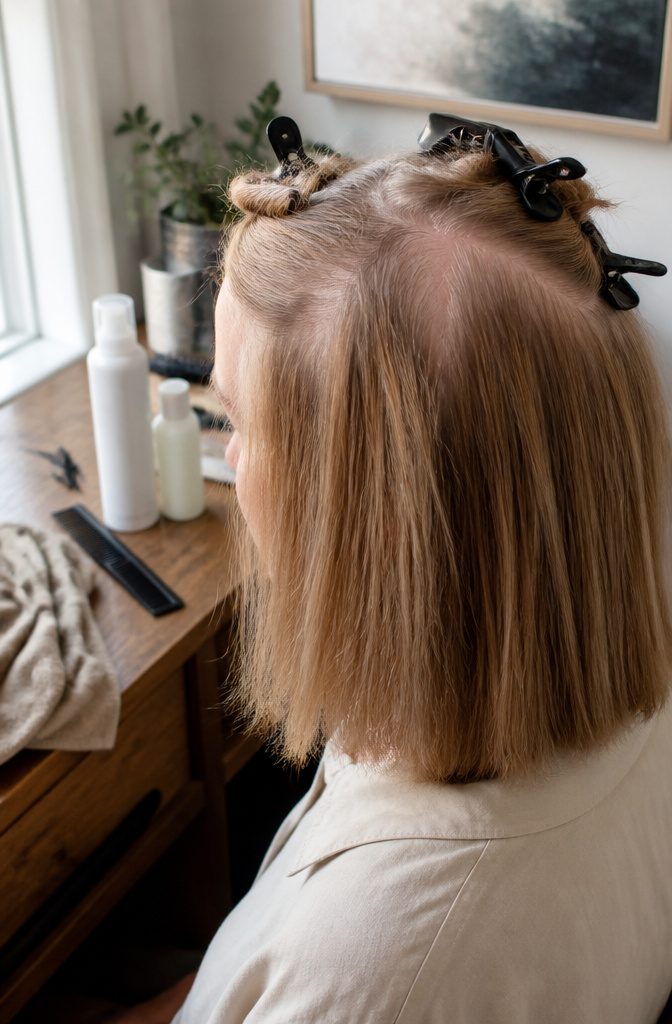
Low density means 50 to 100 hairs per square inch, with more scalp showing through and less natural volume. If you pull your hair into a ponytail and the circumference measures under 2 inches, you’re working with low density.
A wide part, visible scalp between follicles, and a hair tie that wraps around several times before it holds are all signs.
The advantage is fewer strands to manage. The downside is that heavy products weigh everything down fast, leaving hair limp and greasy.
I stick to lightweight lotions rather than thick creams or heavy gels, and skip oily conditioners that add extra weight. Mousses and foams help add texture without the drag.
For more lift, root-clipping works: pin sections at the base while hair dries, then release.
Fluffing out the roots after styling gives similar volume. A blunt cut can make ends look fuller, which helps the overall appearance of thickness.
Medium Density Hair
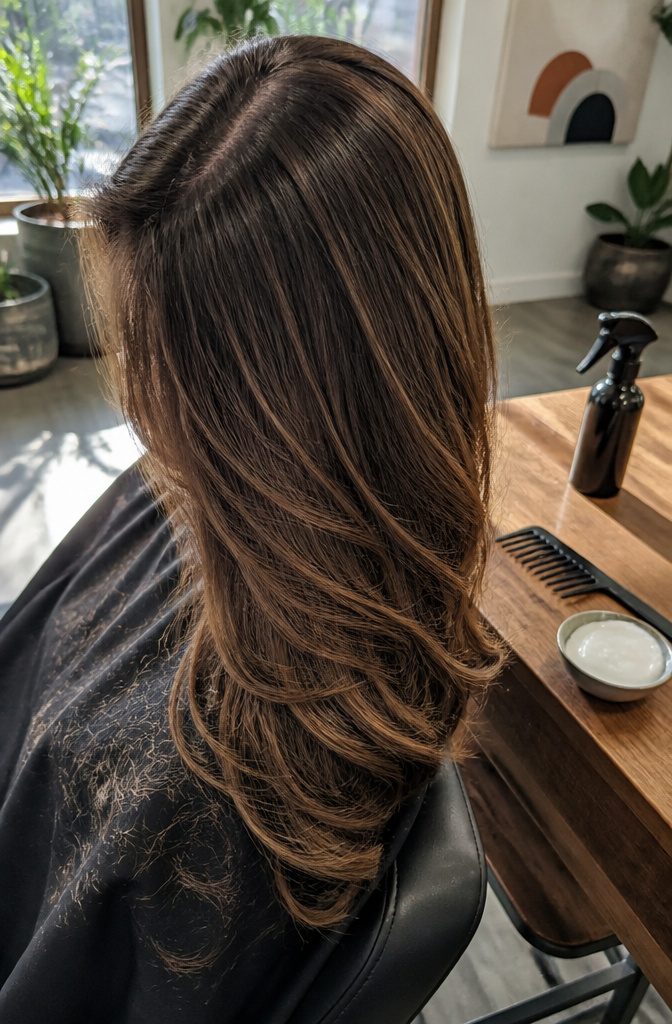
Medium density sits between 100 and 200 hairs per square inch, with some scalp visible through the hair but a generally full appearance overall.
The ponytail test puts this range at 2 to 3 inches in circumference, though one method stretches the upper boundary to 4 inches.
This density offers the most styling flexibility.
You can add volume with the right products or wear hair sleek without it looking thin. The trouble appears as hair grows longer: weight pulls curls downward, flattening the crown while the ends stay full and bouncy.
Some call this Christmas-tree or triangle hair. The right cut takes off enough weight to restore bounce and separation at the roots.
Product choice sits in the middle too. Skip anything too heavy, which risks greasy buildup, but avoid ultra-light formulas that do not deliver enough moisture.
Leave-in treatments work well here because they hold hydration without dragging hair down. Keep trims regular to manage split ends, and limit chemical processing where you can.
High Density Hair
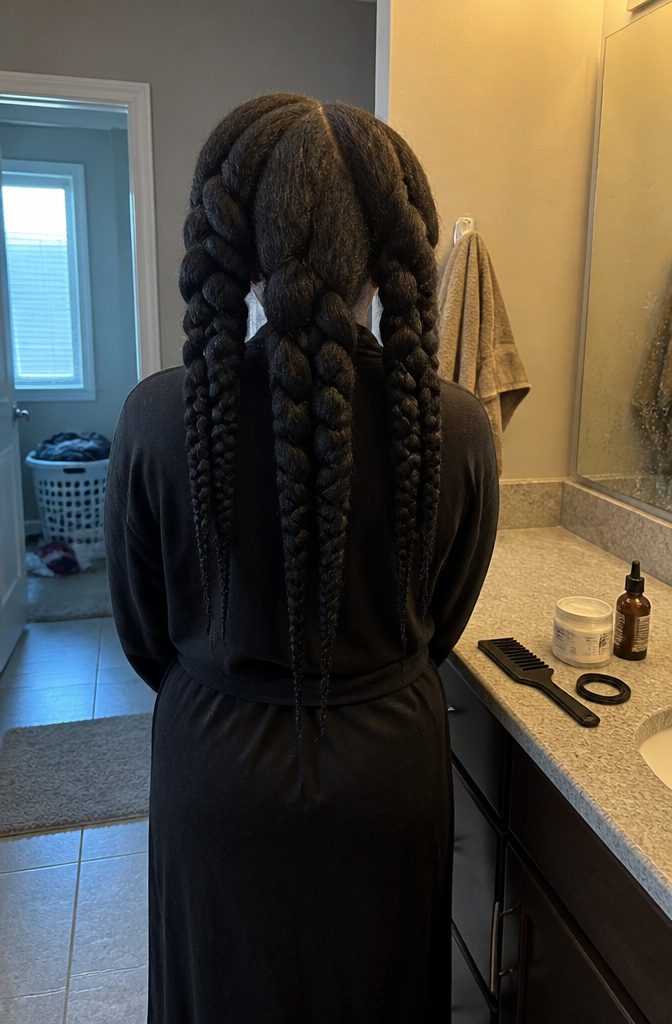
High density hair means 300 to 400 hairs per square inch.
When you look at your scalp, you see little to nothing unless you deliberately part your hair. The overall appearance is full, voluminous, and strong enough that you need a heavy-duty hair tie to hold a ponytail in place.
A ponytail measuring 4 inches in circumference or more generally indicates high density.
That’s a lot of hair to manage, and wash day can feel like an upper-body workout if you’re working with the whole head at once. I find that dividing hair into sections makes both washing and styling more manageable.
After shampooing and conditioning, detangle one section at a time, then loosely braid each finished section to keep it separate. This way the hair stays tangle-free and you’re already set up for sectioned styling, which helps product distribute evenly.
High density hair generally needs less frequent washing than low density hair. Closely spaced strands don’t get dirty as quickly, though your hair type and porosity still matter.
For control, heavier products work better. Serums and oils help reduce frizz, and cuts that remove bulk keep the volume from overwhelming the shape.
Longer layers are one option. Razoring can cause frizz in curly hair, so mention that to your stylist if you’re considering it.
Check Scalp Visibility to Assess Your Density
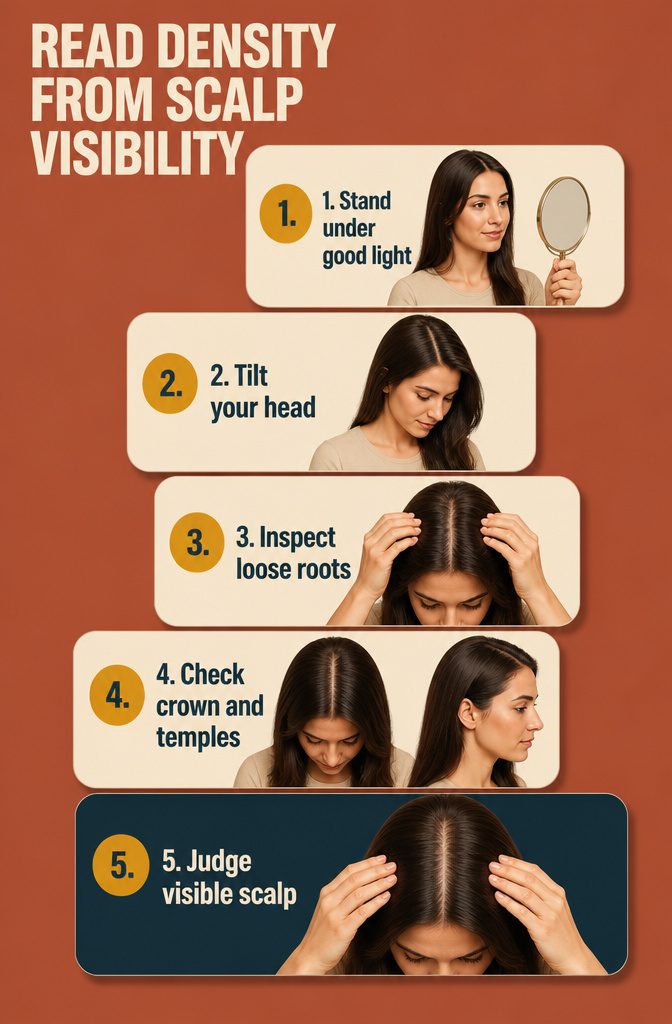
The mirror gives you a quick read.
Stand under good light, tilt your head, and look at your roots. If you see little to no scalp, you likely have high-density hair.
If your scalp shows easily without parting, density is lower. Somewhere in between lands you at medium.
Sources split on prep.
Some say wash your hair first and let it dry completely, no part, no product. Others just say dry hair under overhead light.
All agree on the same basic clue: scalp visibility tells the story. Less scalp visible means more hair per square inch.
Check more than one spot. Density often runs higher at the back of your head than at the crown or temples, so a single glance can mislead.
The part line will always show more scalp than the rest, so judge by what you see when hair is loose and undisturbed.
Use the Ponytail Test for a Quick Estimate
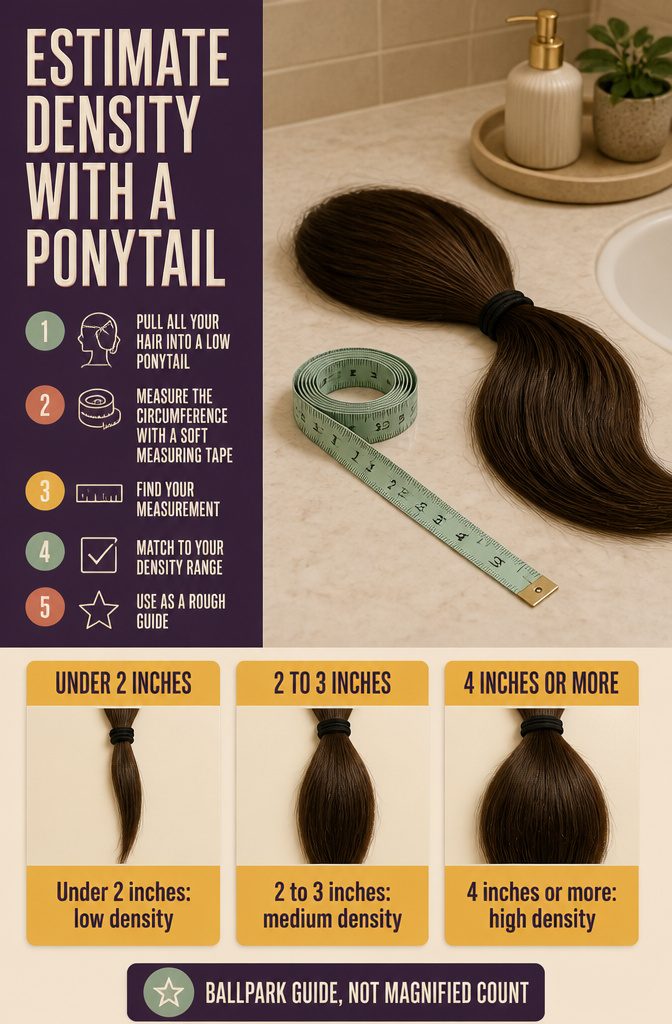
The ponytail test gives you a working number without leaving the house. Pull all your hair into a low ponytail at the nape of your neck, then measure the circumference of that ponytail with a soft measuring tape.
Under 2 inches suggests low density, 2 to 3 inches lands in the medium range, and 4 inches or more signals high density.
Some methods stretch the medium zone from 2 all the way to 4 inches, which makes the cutoffs less sharp but still useful for a rough sorting.
These figures are ballpark guides, not the counts a trichologist would log under magnification.
Hair that sits right at a threshold or that varies in density from crown to nape can blur the lines, and the test assumes you catch all your hair in one clean gather.
Still, a 4-inch ponytail reliably points to more follicles per square inch than most people carry, and that changes which products hold and which cuts flatten.
What Can Change Your Density Over Time
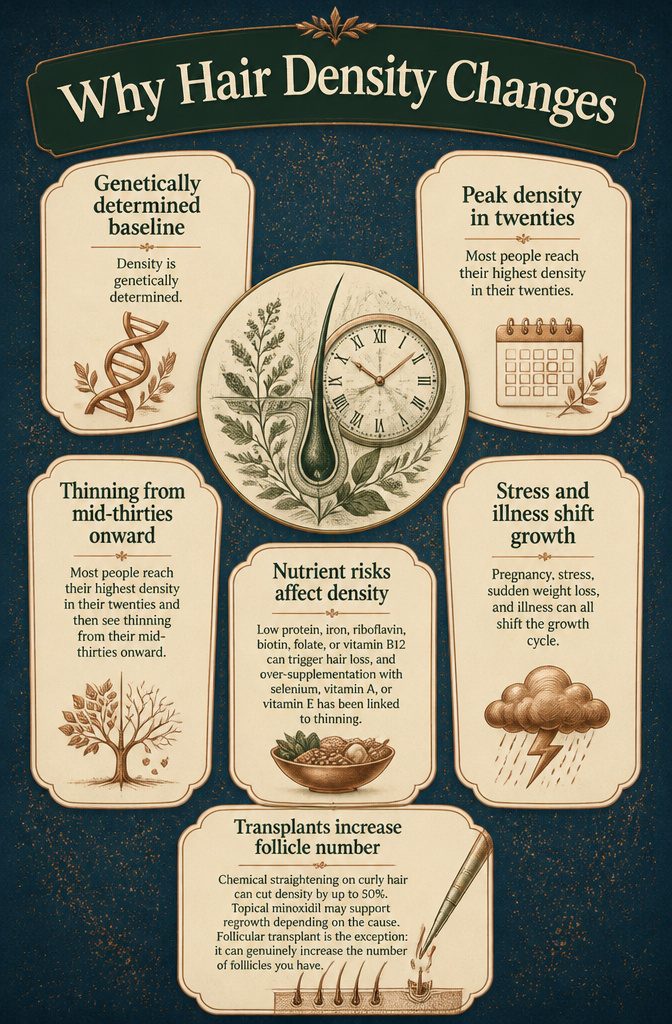
Density is genetically determined, but it can drop with age.
Most people reach their highest density in their twenties and then see thinning from their mid-thirties onward, as strands stay longer in the resting phase of the growth cycle and shed more.
Pregnancy, stress, sudden weight loss, and illness can all shift the growth cycle. Diet matters too.
Low protein, iron, riboflavin, biotin, folate, or vitamin B12 can trigger hair loss, and over-supplementation with selenium, vitamin A, or vitamin E has been linked to thinning. Thyroid disease, autoimmune conditions, and PCOS can reduce density as well.
Chemical straightening on curly hair can cut density by up to 50%.
Topical minoxidil may support regrowth depending on the cause. Follicular transplant is the exception: it can genuinely increase the number of follicles you have.
How Stylists and Trichologists Measure Density
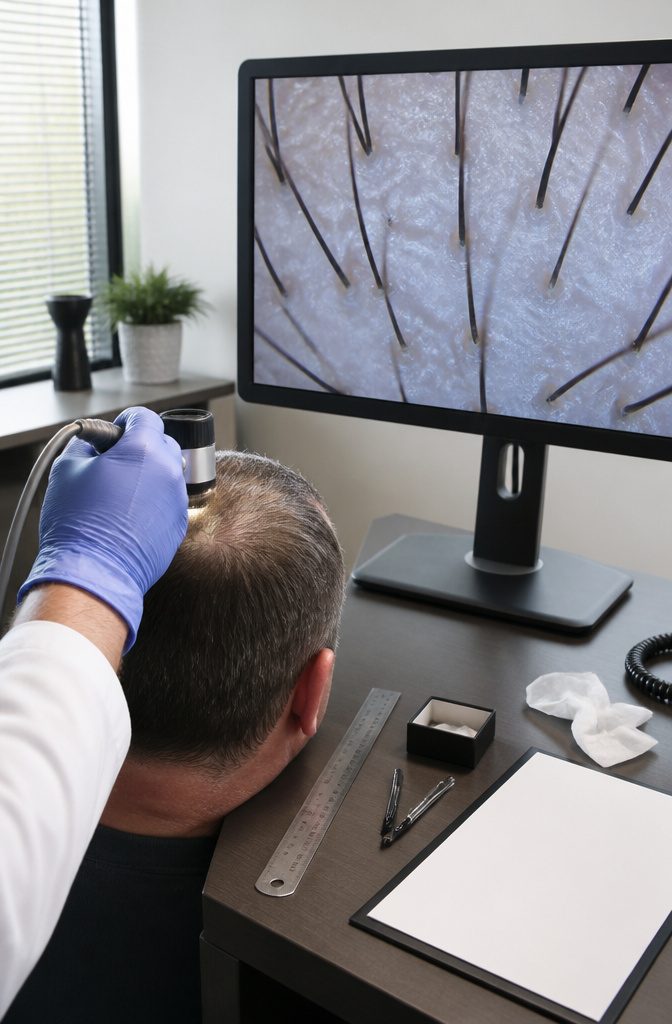
Professionals count strands in a one-inch or one-square-inch section of scalp, though doing that manually across your whole head would take forever.
Trichoscopy magnifies the scalp and individual hairs up to 1000 times, letting researchers measure density accurately and track which growth phase each strand is in.
Two other clinical methods show up in studies: phototrichograms measure how much light each strand absorbs, and autotrichograms measure how much light reflects off the surface. Both usually run together.
Counting by hand is possible if you section off a square inch and start tallying, but the average person has around 2,200 strands in that space, and you would need to repeat the process multiple times to get a sense of variation across your scalp.
A professional stylist can gauge density faster because they have done the strand count often enough to estimate quickly.
Imaging methods and clinical assessment remain the most practical alternatives to spending a Saturday afternoon bent over a mirror with a mental tally.
Product and Styling Choices by Density
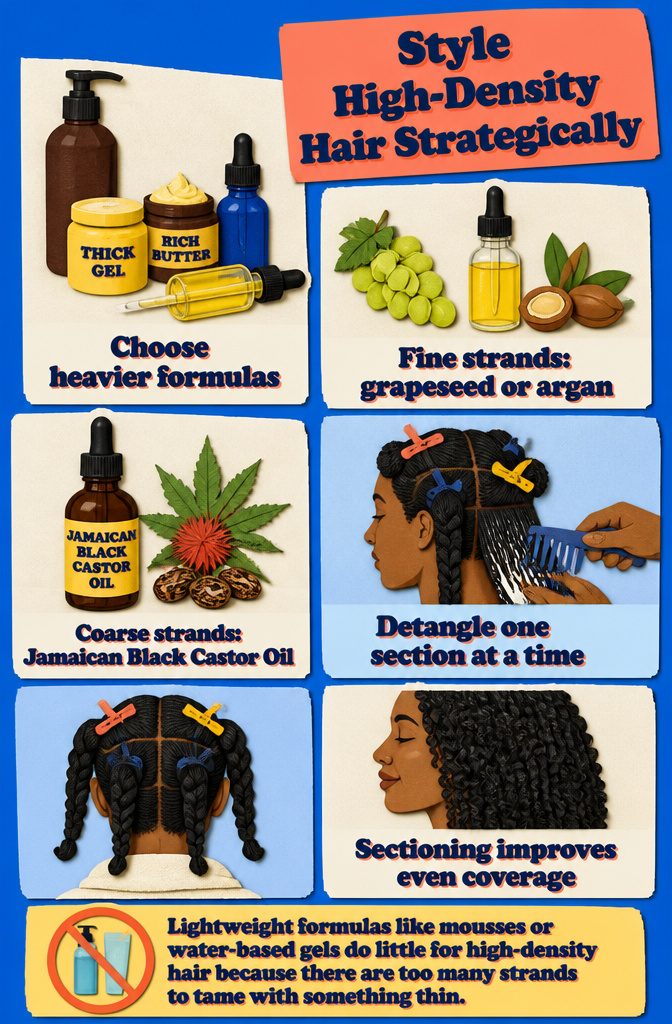
Density changes how much product you need and which kinds work. Lightweight formulas like mousses or water-based gels do little for high-density hair because there are too many strands to tame with something thin.
Heavier products hold better: thick gels, rich butters, serums and oils that coat every strand and help elongate curls or waves so the overall look reads as less bulky.
You’ll also use more of whatever you pick than someone with low-density hair would need for the same result.
The oil you choose depends on strand thickness as much as density.
Jamaican Black Castor Oil works for coarse strands, but it will overwhelm fine ones even when density is high. Grapeseed oil or argan oil suits fine strands better without adding weight that flattens the style.
Working in sections makes high-density hair manageable, especially on wash day. Detangle one section at a time after applying conditioner, loosely braid it to keep it separate, then rinse while the hair is still braided.
You’ll finish with clean, detangled hair already divided and ready for product application. Styling section by section ensures even coverage, which helps curls clump and define instead of frizzing out.
Frequently Asked Questions
What’s the difference between hair density and hair thickness?
Density counts how many strands grow per square inch of your scalp, while thickness measures the width of a single hair.
You can have fine strands packed close together for high density, or coarse strands spaced far apart for low density. The 2 characteristics move independently.
Can you have fine and thick hair at the same time?
Yes, if your strands are fine but you have a lot of them growing close together.
Fine describes the width of each individual hair, while thick in this case refers to high density. The number of hairs makes up for the narrow diameter of each one.
Can hair density change?
Yes, though your baseline is genetic.
Most people reach their highest density in their twenties and see thinning from their mid-thirties onward. Pregnancy, stress, sudden weight loss, illness, diet deficiencies, and chemical straightening can all reduce density over time.
Is it possible to increase hair density?
Follicular transplant is the only method that genuinely increases the number of follicles you have.
Topical minoxidil may support regrowth depending on the cause of thinning. Diet and hydration support healthy hair but cannot create new follicles.
Does high-density hair require more frequent washing?
No, high-density hair generally needs less frequent washing than low-density hair because closely spaced strands don’t get dirty as quickly. Your hair type and porosity still matter, though, and affect how often you should shampoo.
Does shaving your head increase hair density?
No, shaving does not affect hair density or type. Density is determined by the number of follicles you were born with, and shaving only removes the hair shaft above the scalp without changing the follicle itself.
What hair color has the highest density?
Blondes typically have the highest density, followed by brunettes, with red hair lowest. This reflects average follicle counts across natural hair colors, though individual variation exists within each group.